AI Appraisal Estimate

AI-generated estimates · not official valuations

From the user

What was submitted

Photo and notes provided by the user — not generated by AI

Submitted item photo
Submitted photo · June 20, 2026

User's notes

No additional notes provided.

AI analysis below

AI appraisal

AI analysis & estimate

AI-Generated · Verify before acting

Everything below is generated by AI for informational purposes only. AI can make mistakes — the AI may misidentify items or misattribute them (artist, maker, brand, designer, origin, era). This is not an official valuation and should not be used for insurance, sale, tax, estate, legal, or lending purposes — or any decision requiring a certified appraisal. It is not an authoritative claim about any person, brand, or rights holder — do not share or rely on it as a factual statement about a third party. Always consult qualified professionals before making financial decisions.

Read the full disclaimer

AI Identification

·Not independently authenticated·Verify before acting

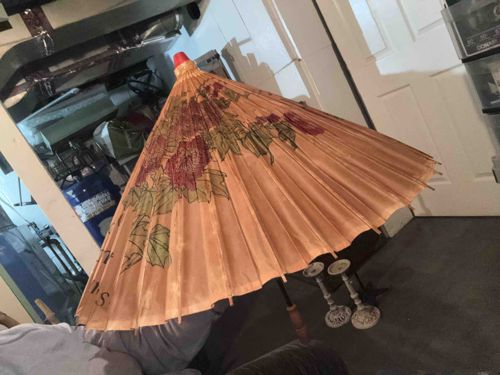
Japanese Wagasa Style Oiled Paper Parasol

Asian Antiques and Collectibles

AI Estimated Value

·Not an official valuation·Verify before acting

$40 - $75

As of June 20, 2026

AI Item Analysis

·AI can make mistakes·Verify before acting
This is a traditional-style Japanese wagasa, or oiled paper parasol, featuring a peach-toned canopy adorned with hand-painted floral motifs. The primary decoration consists of large, deep red or magenta camellias or peonies with green leaves and black outlinings. The construction utilizes a complex bamboo rib structure visible through the translucent paper, secured at the top with a red-capped finial. To the left side of the canopy, there appears to be black calligraphic script or lettering, which may indicate a maker's mark, location, or decorative poem. The paper exhibits a characteristic sheen suggesting it has been treated with linseed or perilla oil for water resistance and durability. Regarding its condition, the parasol shows signs of significant age and brittle texture; there is visible tearing and separation of the paper panels near the outer edges and along the fold lines. Scuffing and color fading are present throughout the canopy, consistent with mid-20th-century origins. The craftsmanship is indicative of traditional artisanal techniques, showcasing high-density bamboo ribbing which creates a sturdy yet elegant silhouette. This item's aesthetic and construction suggest it was likely produced as a functional souvenir or decorative object in the mid-to-late 20th century.
AI Appraisal Report

·AI can make mistakes·Verify before acting
Based on my visual inspection of this Japanese wagasa (oiled paper parasol), I have determined this is a mid-20th-century functional souvenir piece. The construction features characteristic high-density bamboo ribbing and a hand-painted floral motif, likely representing camellias. While the calligraphy suggests an artisanal provenance, the materials and execution are consistent with post-WWII production for the export or domestic tourist market rather than a rare Edo or Meiji period artifact. The condition of the item significantly impacts its valuation. I observed clear signs of desiccation in the paper canopy, particularly the brittle edges and tearing along the fold lines. Traditional oiled paper naturally loses its flexibility over decades, and this example shows typical oxidative degradation. The red pigment remains vibrant, though scuffing and minor losses are visible on the periphery. The market for vintage wagasa is currently soft, as most collectors prioritize 'mint' condition items for interior decor. Comparables in similar distressed condition frequently sell at estate auctions and online marketplaces in the sub-$100 range. The value here is primarily as a decorative 'shabby chic' object rather than a museum-grade specimen. Limitations: My assessment is based solely on the provided description and visual data. A physical inspection is required to determine if the oiling remains tacky or has evolved into 'blooming'—a white powdery residue. Authentication of the maker via the calligraphy would require high-resolution macro photography of the script. Finally, scientific testing of the binding adhesives (animal glue vs. synthetic) would be necessary to definitively confirm a production date earlier than 1950.

Get your items appraised

Instant estimates of your treasures with AI-powered appraisals

Browse More Appraisals