AI Appraisal Estimate

AI-generated estimates · not official valuations

From the user

What was submitted

Photo and notes provided by the user — not generated by AI

Submitted item photo
Submitted photo · May 25, 2026

User's notes

No additional notes provided.

AI analysis below

AI appraisal

AI analysis & estimate

AI-Generated · Verify before acting

Everything below is generated by AI for informational purposes only. AI can make mistakes — the AI may misidentify items or misattribute them (artist, maker, brand, designer, origin, era). This is not an official valuation and should not be used for insurance, sale, tax, estate, legal, or lending purposes — or any decision requiring a certified appraisal. It is not an authoritative claim about any person, brand, or rights holder — do not share or rely on it as a factual statement about a third party. Always consult qualified professionals before making financial decisions.

Read the full disclaimer

AI Identification

·Not independently authenticated·Verify before acting

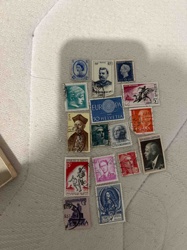
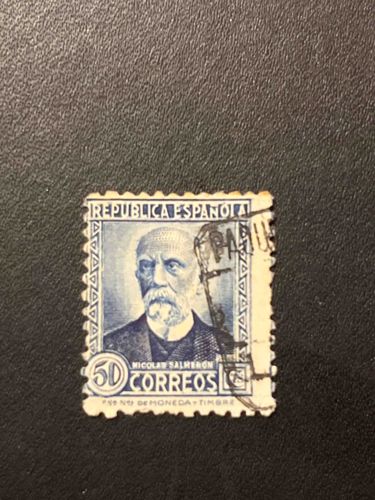
Spain 1931 Second Republic Nicolás Salmerón 50 Centimos Postage Stamp

Philately / Postage Stamps

AI Estimated Value

·Not an official valuation·Verify before acting

$0.50 - $1.50

As of May 25, 2026

AI Item Analysis

·AI can make mistakes·Verify before acting
This is a blue-toned postage stamp from the Second Spanish Republic, issued circa 1931-1932. It features a portrait of Nicolás Salmerón, who served as a President of the First Spanish Republic. The stamp is printed on paper with a perforated edge typical of standard postal issues from the early 20th century. The central design is an engraved-style portrait of Salmerón with his name inscribed below. The top of the frame reads REPUBLICA ESPANOLA, while the bottom denotes the denomination as 50 CORREOS. The very bottom margin mentions FNMT (Fabrica Nacional de Moneda y Timbre), the Spanish national mint and stamp printer. In terms of condition, the stamp shows a heavy black circular date stamp (CDS) or postal cancellation, which obscures the upper right quadrant of the image and the word CORREOS. The perforations are somewhat uneven, with a significant 'short perf' or tear at the bottom right corner and some minor toning (yellowing) visible along the top edge, suggesting oxidation of the paper or adhesive over time. The portrait itself is well-executed with fine line work and shading, indicative of the quality engraving standards of the period. The centering of the image is slightly shifted toward the bottom left side of the paper within the perforations.

AI Appraisal Report

·AI can make mistakes·Verify before acting
I have examined the digital image of the 1931 Spain 50 Centimos stamp featuring Nicolás Salmerón. The stamp appears to be a genuine issue from the Fábrica Nacional de Moneda y Timbre (FNMT) based on the engraving style and typography. However, the condition is significantly compromised. The heavy circular date stamp (CDS) constitutes a 'heavy cancel,' which is less desirable than a light or 'socked-on-the-nose' cancellation. Furthermore, the physical integrity is marred by uneven perforations and a notable short perforation at the bottom right, which drastically reduces the grade. The visible toning along the upper edge suggests the onset of foxing or environmental oxidation, further impacting the stamp's long-term preservation and value. This specific issue was produced in large quantities as part of the definitive series for the Second Republic, making it very common in the philatelic market. Comparable examples in used condition are frequently found in bulk packets or 'kiloware' and hold minimal individual retail value. Highly graded, mint never hinged (MNH) examples command higher premiums, but cancelled copies with physical defects like this one are generally valued at the minimum catalog price. While the design and printing appear consistent with known specimens, a definitive authentication would require a physical inspection to check for repairs, original gum (if applicable), and paper thickness. Scientific testing via long-wave UV light would be necessary to rule out chemical cleaning or hidden thins that are not visible in the provided image. Provenance documentation is not typically required for stamps of this low valuation.

Get your items appraised

Instant estimates of your treasures with AI-powered appraisals

Browse More Appraisals