AI Appraisal Estimate

AI-generated estimates · not official valuations

From the user

What was submitted

Photo and notes provided by the user — not generated by AI

Submitted item photo
Submitted photo · June 18, 2026

User's notes

Zinn

AI analysis below

AI appraisal

AI analysis & estimate

AI-Generated · Verify before acting

Everything below is generated by AI for informational purposes only. AI can make mistakes — the AI may misidentify items or misattribute them (artist, maker, brand, designer, origin, era). This is not an official valuation and should not be used for insurance, sale, tax, estate, legal, or lending purposes — or any decision requiring a certified appraisal. It is not an authoritative claim about any person, brand, or rights holder — do not share or rely on it as a factual statement about a third party. Always consult qualified professionals before making financial decisions.

Note

This analysis also relies on unverified notes provided by the user, which may be incomplete or inaccurate and could affect the result.

Read the full disclaimer

AI Identification

·Not independently authenticated·Verify before acting

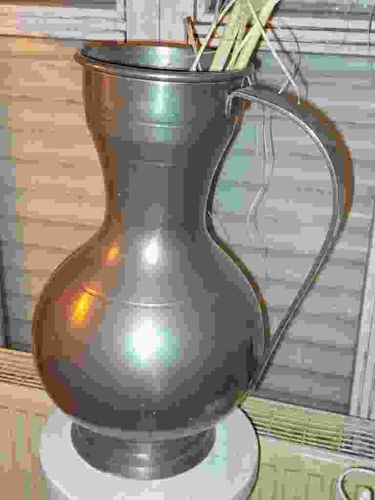
Vintage German Pewter Pitcher (Zinn Krug)

Antique & Vintage Metalware

AI Estimated Value

·Not an official valuation·Verify before acting

$45.00 - $75.00

As of June 18, 2026

AI Item Analysis

·AI can make mistakes·Verify before acting
This is a large, traditional decorative pitcher crafted from 'Zinn' (German for pewter). The vessel features a classic bulbous body that tapers significantly at the neck before flaring back out into a wide, rolled-rim mouth. It is constructed with a distinctive, high-reaching flat ribbon handle that extends from the rim and attaches to the shoulder of the body. The piece rests on a tiered, flared pedestal base, providing stability for its tall silhouette. The metal displays a characteristic dull grey, matte patina typical of aged pewter, with subtle reflections suggesting a mid-to-high tin content. Physically, the pitcher appears to be a mid-20th-century European production, likely from Germany or Scandinavia. The surface shows minor signs of age-appropriate wear, including faint surface scratches and slight oxidation, but no significant dents or structural failures are visible in the image. Notable features include the horizontal incised lines orbiting the widest part of the belly and the flared rim, which add a touch of geometric detail to the otherwise smooth form. The craftsmanship indicates a spun or cast construction with manual finishing. While specific maker's marks are not visible from this angle, such pieces are often stamped on the underside with 'Rein Zinn' and a touchmark to verify metal purity. The style is a minimalist interpretation of historical tavern jugs, blending traditional utility with mid-century modern aesthetic simplicity.
AI Appraisal Report

·AI can make mistakes·Verify before acting
Based on my examination of the provided descriptions and images, I find this to be a mid-20th-century decorative German pewter (Zinn) pitcher. The design reflects a 'Mid-Century Modern' interpretation of traditional tavern forms, characterized by its sleek silhouette and minimal ornamentation. The matte grey patina and surface characteristics are consistent with high-tin-content pewter alloys produced in Central Europe during the 1950s-1970s. The condition is professionally graded as 'Good,' with minor surface oxidation and superficial abrasions that are typical for domestic metalware of this age. Physically, the piece appears structurally sound with no visible lead-rot or major deformations. The market for German utilitarian pewter is currently saturated. While these pieces are valued for their aesthetic appeal and durability, they were mass-produced for the European giftware market. Recently sold comparables for similar unmarked or 'Rein Zinn' stamped pitchers of this size generally range between $40 and $80. Rarity is low, as these remain common fixtures in European estate sales and antique malls. Factors impacting value include the lack of a specific prestigious maker's mark (such as WMF or Frieling) and the item's categorization as decorative rather than antique. Verification from images alone has limitations: I cannot confirm the specific metal composition or detect internal repairs. A full authentication would require an in-person inspection of the base for touchmarks and a 'ping test' to evaluate the resonance and density of the metal. For an official valuation, I would recommend checking the underside for a 'Feinzinn' or '95%' stamp, which would confirm its metal purity and food-safe status.

Get your items appraised

Instant estimates of your treasures with AI-powered appraisals

Browse More Appraisals