AI Appraisal Estimate

AI-generated estimates · not official valuations

From the user

What was submitted

Photo and notes provided by the user — not generated by AI

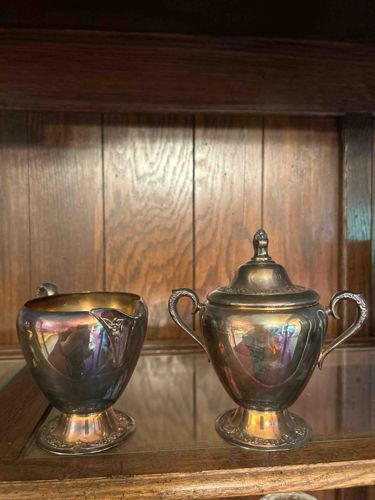
Submitted item photo
Submitted photo · June 9, 2026

User's notes

No additional notes provided.

AI analysis below

AI appraisal

AI analysis & estimate

AI-Generated · Verify before acting

Everything below is generated by AI for informational purposes only. AI can make mistakes — the AI may misidentify items or misattribute them (artist, maker, brand, designer, origin, era). This is not an official valuation and should not be used for insurance, sale, tax, estate, legal, or lending purposes — or any decision requiring a certified appraisal. It is not an authoritative claim about any person, brand, or rights holder — do not share or rely on it as a factual statement about a third party. Always consult qualified professionals before making financial decisions.

Read the full disclaimer

AI Identification

·Not independently authenticated·Verify before acting

Vintage Silver-Plated Creamer and Covered Sugar Bowl Set

Antique/Vintage Metalware

AI Estimated Value

·Not an official valuation·Verify before acting

$45.00 - $75.00

As of June 9, 2026

AI Item Analysis

·AI can make mistakes·Verify before acting
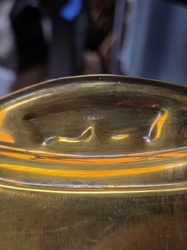
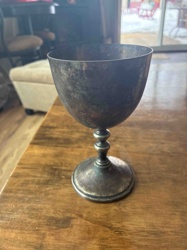
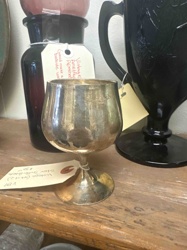
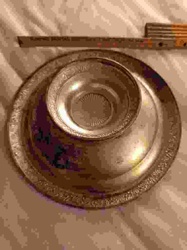
This is a two-piece vintage tea service set consisting of a pedestal creamer and a matching double-handled sugar bowl with a lid. The items appear to be silver-plated, characterized by a heavy iridescent oxidation or 'rainbow tarnish' across the bellied bodies, which indicates a presence of silver over a base metal. The design features a mid-20th-century aesthetic with Art Deco or Hollywood Regency influences, specifically noted by the sleek, bulbous forms and the elegant floral or foliate embossing along the flared footed bases and the rim of the sugar bowl lid. The creamer features a sharp, integrated spout with a small decorative leaf motif at the join of the handle. The sugar bowl is topped with a domed lid featuring a decorative finial. Both pieces exhibit significant surface tarnishing ranging from deep charcoal to iridescent golds and purples, which may hide minor scratches or scuffs typical of age. There are no visible dents or deep gouges in the metal, suggesting good structural integrity. While no maker's mark is visible in the image, the craftsmanship suggests a reputable mid-century manufacturer such as International Silver or Reed & Barton. The interior of the creamer shows a yellowish tint, which may be a remnants of a gold wash or further heavy tarnish.
AI Appraisal Report

·AI can make mistakes·Verify before acting
I have conducted a visual examination of this silver-plated creamer and sugar bowl set. The pieces exhibit a mid-20th-century aesthetic consistent with the Hollywood Regency style. The 'rainbow tarnish' suggests a genuine silver plating over a base metal, likely copper or nickel silver. The structural integrity appears sound with no visible denting; however, the heavy oxidation indicates the set has been stored in a high-sulfur environment. While the patina is aesthetically favorable to some collectors, it may obscure underlying 'plate loss' (bleeding of the base metal), which would negatively impact value. The market for mid-century silver-plated hollowware is currently saturated. Sets like these were mass-produced by firms such as International Silver, Sheridan, or Reed & Barton. In today’s secondary market, these items are valued primarily for their decorative utility rather than as rare antiques or bullion content. High-end retail 'shabby chic' boutiques might list these at the higher end of the range, while auction realizations typically sit at the lower end. Final authentication and valuation are limited by the digital nature of this inspection. I cannot verify the presence of hallmark stamps on the underside, which are vital for identifying the specific manufacturer and confirming if the interior is indeed a gold wash or simply aged residue. A definitive appraisal would require a physical inspection to check for 'pitting' beneath the tarnish and a weight/acid test to rule out solid sterling silver (though the tarnish pattern strongly suggests plating). Provenance documentation or original sales records would also assist in establishing a more precise historical lineage.

Get your items appraised

Instant estimates of your treasures with AI-powered appraisals

Browse More Appraisals