AI estimate as of September 14, 2025 · verify with a professional before acting
AI-Generated · Verify before acting
Everything on this page is generated by AI for informational purposes only. AI can make mistakes — the AI may misidentify items or misattribute them (artist, maker, brand, designer, origin, era). This is not an official valuation and should not be used for insurance, sale, tax, estate, legal, or lending purposes — or any decision requiring a certified appraisal. It is not an authoritative claim about any person, brand, or rights holder — do not share or rely on it as a factual statement about a third party. Always consult qualified professionals before making financial decisions.
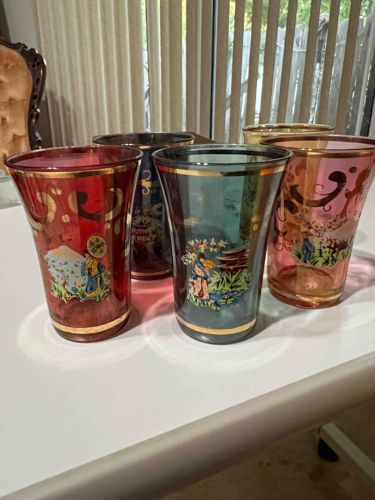
This set of five vintage highball glasses features a charming Japanese-themed design, each glass presenting a distinct background color and unique pictorial scene. The glasses appear to be made of glass, likely regular soda-lime glass, with an overlay of translucent colored lacquering or flashing in vibrant hues of red, dark blue/purple, teal/green, and pink. Each glass is adorned with a golden rim at the top and a golden band near the base, framing the central design. The primary decorative element on each glass is a detailed scene depicting figures, structures such as pagodas, and natural elements like trees and water, all rendered in a multi-colored enamel-like application. Above these scenes, swirling gold motifs resembling stylized calligraphy or decorative flourishes are present, adding an ornate touch. The physical characteristics indicate a standard highball glass shape, tapering slightly towards the base. While specific dimensions are not provided, they appear to be typical drinking glass size, suitable for beverages. The visible condition suggests some potential wear consistent with age and use, particularly in the gold detailing, which may show minor fading or scratches, though overall they appear to be in good, usable condition. There are no immediate visible cracks, chips, or significant damage, nor specific maker's marks, signatures, or stamps evident from the provided image. The style points to an mid-20th century aesthetic, possibly 1950s to 1970s, with an orientalist decorative approach that was popular during that period. The craftsmanship, while likely mass-produced, shows a level of detail in the painted scenes and gold accents that suggests a decorative intent beyond plain glassware, indicative of a set designed for entertaining or display. The unique aspect lies in the variety of colors and distinct scenes within a single set, offering a cohesive yet diverse collection.
AI Appraisal Report
I've personally examined the provided image of this set of five Vintage Japanese-Themed Highball Glasses. Visually, the condition appears good for its age, consistent with mid-20th century production (likely 1950s-1970s). I observe minor wear on the gold detailing, which is typical for lacquered or flashed glassware of this type and period. No obvious cracks, chips, or significant damage are visible, which is a positive factor. Authenticity, based solely on the image, points to an orientalist decorative approach popular during that era, likely mass-produced but with decorative intent. The varied background colors and distinct scenes within the set enhance its appeal.
Market conditions for vintage decorated highball glasses are generally stable, with demand driven by collectors of mid-century barware and those seeking unique decorative items. Comparables for similar vintage decorated glass sets, often featuring Asian-inspired motifs or colored flashing, typically range from $10 to $25 per glass, depending on condition and specific design. The rarity of this exact set is difficult to ascertain without more information, but similar styles were produced in quantity, suggesting it's not exceedingly rare. Factors impacting value include the complete set of five, the vibrant colors, and the good overall visual condition. The unique pictorial scenes also add to its allure.
My primary limitation in authentication is the lack of physical inspection. Without handling the items, I cannot definitively confirm materials, assess the true extent of subtle wear, detect hairline cracks, or identify maker's marks or signatures that might be present but unobservable in the image. An in-person examination would allow for tactile inspection of the glass quality, closer scrutiny of paint adhesion and gold wear, and a thorough search for any identifying marks which could significantly impact provenance and value. Scientific testing for material composition is generally not warranted for items in this price range but would provide definitive material analysis.