These notes were written by the person who submitted this item. Appraiser.AI has not verified them, and the AI's identification and estimate may rely on them.
AI Estimated Value
Not an official valuation
$5 - $15
AI estimate as of September 19, 2025 · verify with a professional before acting
AI-Generated · Verify before acting
Everything on this page is generated by AI for informational purposes only. AI can make mistakes — the AI may misidentify items or misattribute them (artist, maker, brand, designer, origin, era). This is not an official valuation and should not be used for insurance, sale, tax, estate, legal, or lending purposes — or any decision requiring a certified appraisal. It is not an authoritative claim about any person, brand, or rights holder — do not share or rely on it as a factual statement about a third party. Always consult qualified professionals before making financial decisions.
This analysis also relies on unverified notes provided by the user, which may be incomplete or inaccurate and could affect the result.
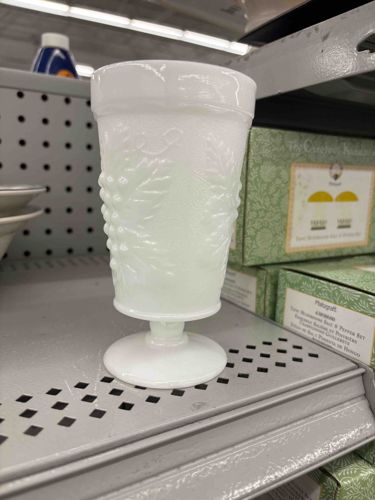
This item is a white milk glass pedestal cup, likely a goblet or a shorter tumblers/juice glass form, featuring an intricately embossed grape vine pattern. The cup stands on a short, rounded pedestal base, which transitions smoothly into the main body of the cup. The material is opaque white glass, characteristic of milk glass, which gives it a soft, translucent quality when held up to light, though it appears solid white in the provided image. The embossed design covers the majority of the cup's exterior, displaying clusters of grapes interspersed with detailed vine leaves. The rim of the cup is smooth and slightly flared, lacking any additional decorative elements. The overall construction suggests a molded glass manufacturing process, common for milk glass items. There are no visible chips, cracks, or significant wear indicative of heavy use or damage, and the surface appears glossy and well-maintained, suggesting good condition. No specific maker's marks or signatures are discernible from the images, which is common for many mass-produced milk glass pieces. Based on the style and widespread use of such patterns, this piece likely dates from the mid-20th century, possibly the 1950s to 1970s, a period when milk glass was highly popular. The craftsmanship, while not artisanal, reflects the typical quality of decorative tableware from that era, offering a charming and functional aesthetic.
AI Appraisal Report
Based on my visual examination of the provided image, this white milk glass pedestal cup with an embossed grape vine pattern appears to be in very good condition. The surface is glossy, and I do not observe any chips, cracks, or significant wear. The opaque white glass is typical of milk glass. Authenticity, based solely on the image, seems clear; it presents as a genuine milk glass piece derived from a molded manufacturing process.
Milk glass items, particularly those with common patterns like grape vines, were mass-produced from the mid-20th century, likely between the 1950s and 1970s. This broad availability means they are not rare. The market for such items is generally steady but not robust. Demand is primarily driven by collectors of vintage glassware or those decorating with a mid-century aesthetic. We are not dealing with a rare or highly collectible manufacturer, which tends to keep values in a modest range. Comparable items, ranging from individual pieces to small sets, typically sell for $5 to $20 per item, depending on condition and pattern desirability. Given the common pattern and the fact that it is a single cup, its value is on the lower end of that spectrum.
Factors impacting value include its good condition, but inversely, the common design and lack of a discernible maker's mark or rarity. For full authentication, a physical inspection would allow me to check for invisible flaws, manufacturing irregularities, and more accurately assess the glass quality. While the image is helpful, seeing the piece in person could confirm its age more precisely and rule out modern reproductions, although this is unlikely for such an item. I would also look for any faint mold marks or subtle variations that might point to a specific manufacturer, which could marginally increase its value, but it is unlikely to significantly impact this item's marketability.