AI estimate as of August 31, 2025 · verify with a professional before acting
AI-Generated · Verify before acting
Everything on this page is generated by AI for informational purposes only. AI can make mistakes — the AI may misidentify items or misattribute them (artist, maker, brand, designer, origin, era). This is not an official valuation and should not be used for insurance, sale, tax, estate, legal, or lending purposes — or any decision requiring a certified appraisal. It is not an authoritative claim about any person, brand, or rights holder — do not share or rely on it as a factual statement about a third party. Always consult qualified professionals before making financial decisions.
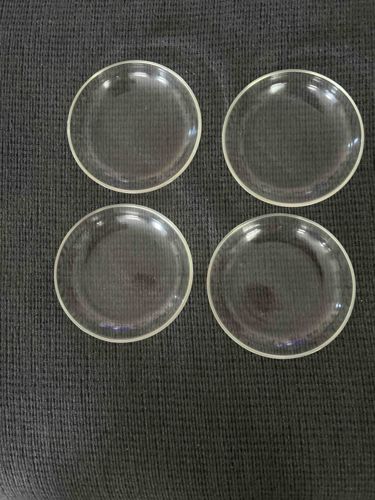
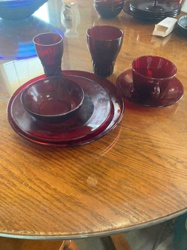
This set consists of four small, circular, clear glass dishes, likely intended for use as individual butter pats, small sauce dishes, or possibly coin/trinket dishes. Each dish is uniformly clear, suggesting the material is either soda-lime glass or possibly borosilicate glass given their appearance of durability. They feature a distinct shallow well in the center, surrounded by a raised rim. The rim is clearly defined and appears to be slightly thicker than the base of the dish, contributing to its structural integrity. The edges of the rim appear smooth and finished, indicating good craftsmanship, with no visible chips or rough spots that would suggest poor quality or damage. The dishes are approximately equal in size and shape, indicating a mass-produced or at least consistent manufacturing process. There are visible smudges and minor dust particles on the surface of the glass, suggesting they have been handled or stored without immediate cleaning, but no significant scratches, cracks, or chips are apparent from the provided image, which might imply good condition or careful storage. There are no discernible maker's marks, signatures, or specific patterns that would suggest a particular manufacturer or artistic style. Based on their simple, functional design, they likely belong to a modern or mid-20th-century style period, prioritizing utility and clear aesthetics. The transparency of the glass allows light to pass through, creating reflections and slight distortions, which are characteristic of clear glass objects. The uniform thickness and clear nature suggest a good quality of glass, free from obvious imperfections like bubbles or streaks that can sometimes be found in lower-quality glass production. Their small size and flat bases suggest stability when placed on a surface.
AI Appraisal Report
I have examined the provided image of this set of four clear glass butter pats/small dishes. Visually, their condition appears very good, with no evident chips, cracks, or significant scratches, beyond minor surface smudges and dust. Their uniform size and clear, simple design suggest a mass-produced item, likely from the mid-20th century onwards, prioritizing functionality. No maker's marks or distinctive patterns are visible, which limits the ability to attribute them to a specific manufacturer or period without further information.
From a market perspective, clear glass butter pats of this generic design are relatively common. They fall into the utilitarian glassware category, which typically does not command high prices unless associated with a well-known brand (e.g., Fostoria, Heisey) or a particularly desirable historical period. Comparables in online marketplaces or antique shops typically range from a few dollars per piece to under $20 for a set, depending on condition and any subtle unique features. There is a consistent, but not robust, demand for such items for everyday use or as part of larger minimalist decor schemes.
The rarity factor for these specific items is low due to their generic nature. Factors impacting value negatively include the lack of any discernible maker's marks, unique design elements, or historical significance. Their transparency highlights the presence of any imperfections, but none are apparent here. The primary limitation in assessing authenticity and precise age from images alone is the inability to perform a physical inspection. Without hands-on examination, I cannot check for subtle mold lines, glass composition (e.g., presence of lead characteristic of older glass), weight, or any micro-scratches that might indicate true age or wear. Provenance documentation could also significantly impact the perceived value, but none is available here. Scientific testing, such as spectroscopy, could confirm glass composition but is unwarranted for items of this common type.