AI Appraisal Estimate

AI-generated estimates · not official valuations

From the user

What was submitted

Photo and notes provided by the user — not generated by AI

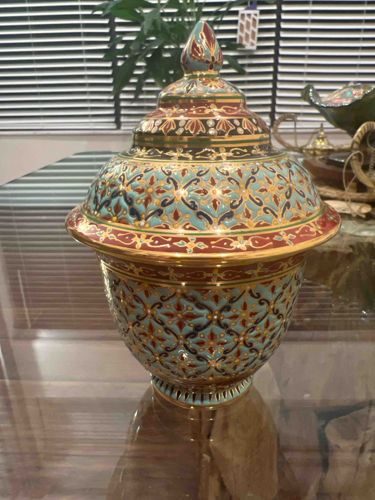
Submitted item photo
Submitted photo · June 23, 2026

User's notes

No additional notes provided.

AI analysis below

AI appraisal

AI analysis & estimate

AI-Generated · Verify before acting

Everything below is generated by AI for informational purposes only. AI can make mistakes — the AI may misidentify items or misattribute them (artist, maker, brand, designer, origin, era). This is not an official valuation and should not be used for insurance, sale, tax, estate, legal, or lending purposes — or any decision requiring a certified appraisal. It is not an authoritative claim about any person, brand, or rights holder — do not share or rely on it as a factual statement about a third party. Always consult qualified professionals before making financial decisions.

Read the full disclaimer

AI Identification

·Not independently authenticated·Verify before acting

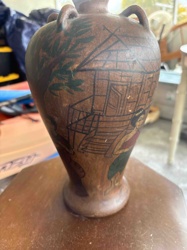
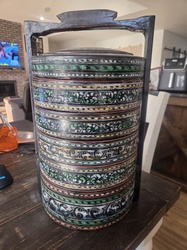
Thai Benjarong Covered Urn

Southeast Asian Decorative Arts / Ceramics

AI Estimated Value

·Not an official valuation·Verify before acting

$450.00 - $650.00

As of June 23, 2026

AI Item Analysis

·AI can make mistakes·Verify before acting
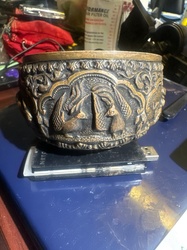
This is a Thai Benjarong porcelain jar with a matching domed lid, likely dating to the late 20th or early 21st century. The vessel features a classic ovoid body tapering to a pedestal foot, topped with a tiered, pagoda-style lid culminating in a pointed finial. The piece is hand-painted using the traditional five-color enamel technique (Benjarong translates to 'Five Colors'), though this specific example utilizes a rich palette of turquoise blue, iron red, forest green, and white, all heavily accented with 18k or 24k gold leaf gilding. The decorative motif is an intricate, repetitive floral lattice or 'Lai Thai' pattern that covers the entire surface area with exceptional precision. The relief-like texture of the enamel suggests high-quality craftsmanship where the minerals are layered to create a three-dimensional effect. The gold borders are bright and showcase minimal wear, indicating the piece has been well-maintained as a decorative item rather than used for storage. There are no visible chips, cracks, or significant loss to the enamel. The internal ceramic body appears to be a fine white porcelain. This style of ceramics was historically reserved for the Thai royal court and represents a significant artisan tradition in Southeast Asian decorative arts.
AI Appraisal Report

·AI can make mistakes·Verify before acting
Upon visual examination of this Benjarong covered urn, I find it to be an excellent contemporary representative of the 'Lai Thai' floral lattice tradition. The piece demonstrates superior craftsmanship in the application of vitreous enamels, particularly the raised relief texture of the floral motifs which signifies a high level of artisanal skill. The 18k-24k gold gilding remains remarkably bright with negligible oxidation or wear, suggesting it has been preserved in a controlled environment as a cabinet piece. I note no visible crazing, chips, or restoration on the finial or tiered lid, which are often the first areas to sustain damage. The market for contemporary Benjarong is currently stable, driven primarily by collectors of Southeast Asian decorative arts and high-end interior designers. This specific palette—utilizing a turquoise ground—is particularly desirable compared to standard white-ground examples. Comparables for jars of this size and complexity typically realize between $400 and $700 at specialty auction houses or boutique galleries. Because this piece lacks the 'Thephanom' (angel) motif often associated with 19th-century royal commissions, it is appropriately classed as a high-quality modern revival rather than an antique. Please note that this appraisal is based on photographic evidence. A definitive valuation would require an in-person inspection to verify the hallmark on the base, weigh the gold content, and use UV-light to confirm the absence of professional repairs. Full authentication would involve reviewing provenance documentation or original purchase receipts from recognized Thai kilns (such as those in Samut Sakhon). Without physical handling to assess the weight and resonance of the porcelain, this remains a professional estimate of fair market value.

Get your items appraised

Instant estimates of your treasures with AI-powered appraisals

Browse More Appraisals