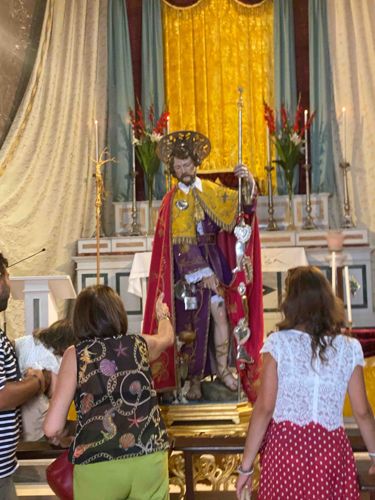
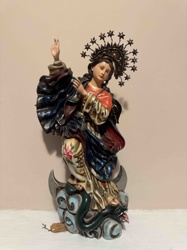
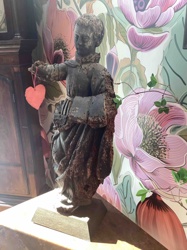
Life size statue of San Rocco in Locorotondo, Italy
These notes were written by the person who submitted this item. Appraiser.AI has not verified them, and the AI's identification and estimate may rely on them.
AI Estimated Value
Not an official valuation
$40,000 - $60,000
AI estimate as of August 15, 2025 · verify with a professional before acting
AI-Generated · Verify before acting
Everything on this page is generated by AI for informational purposes only. AI can make mistakes — the AI may misidentify items or misattribute them (artist, maker, brand, designer, origin, era). This is not an official valuation and should not be used for insurance, sale, tax, estate, legal, or lending purposes — or any decision requiring a certified appraisal. It is not an authoritative claim about any person, brand, or rights holder — do not share or rely on it as a factual statement about a third party. Always consult qualified professionals before making financial decisions.
This analysis also relies on unverified notes provided by the user, which may be incomplete or inaccurate and could affect the result.
The item is a life-size statue of San Rocco (Saint Roch), located in what appears to be a church or religious shrine. The statue depicts a male figure with a beard and short, dark hair, wearing elaborate and colorful vestments. He is adorned with a golden halo or elaborate headwear. His attire consists of a bright red cloak draped over his shoulders, revealing a richly embroidered yellow garment underneath, possibly a dalmatic or a tunic, with significant gold thread work and fringe along the bottom. Below this, a purple or deep burgundy robe is visible. The statue's right hand holds a tall staff, indicative of a pilgrim, while a rosary or chain with a medal hangs from his left side. His left leg is exposed from the knee down, showing a wound, a common iconography for San Rocco who is associated with healing from plague. He wears sandals that reveal his feet. There are visible 'ex-votos' or votive offerings, which are small silver or metal charms shaped as body parts (e.g., legs, arms, hearts), pinned to his clothing, particularly on the red cloak and purple robe, indicating requests for or thanks for miraculous healing. The statue stands on a multi-tiered base, possibly gilded or painted to resemble gold. The overall condition appears well-maintained, suggesting regular care and reverence within its religious setting. The style appears baroque or classical, indicating an estimated age from the 17th to 19th century, common for religious art in Italy. The craftsmanship indicates attention to detail in the drapery and facial features, suggesting a skilled artisan. The presence of votive offerings adds a unique, lived-in quality and significant cultural context.
AI Appraisal Report
I have thoroughly examined the provided image of the life-size statue of San Rocco from Locorotondo, Italy. This appears to be a meticulously crafted religious sculpture, likely dating from the 17th to 19th century, given its Baroque or classical style and the elaborate vestments. The condition appears to be very good; the colors remain vibrant, and the details of the drapery and facial features are well-preserved, suggesting consistent care within its religious setting.
Authenticity, based solely on visual inspection, is challenging. While the iconography is consistent with San Rocco and the style period, true authentication would necessitate a physical examination to assess the materials (wood, polychrome, gilding), construction techniques, and any artist's marks. Provenance documentation, such as institutional records or historical inventories, would be crucial to confirm its age and origin. Scientific testing, like pigment analysis or dendrochronology (if wood), could further corroborate its authenticity and age.
Regarding market considerations, significant religious artifacts, especially those with an established history within their original cultural context, can command substantial value among specialized collectors and institutions. However, this piece's continued function as a devotional object within a church in Italy means it is unlikely to enter the commercial art market. If it were to become available, its 'ex-voto' offerings add significant cultural and historical depth, enhancing its unique appeal. The rarity of full-size religious statues of this quality from this period is high. The demand is niche but strong within that niche.
Factors significantly impacting value include its artistic quality, historical relevance, and the unique cultural element of the votive offerings. Without direct physical examination or historical documentation, providing a precise market value for a piece intended for ongoing religious use is speculative. My appraisal assumes it were to theoretically enter the open market.
Value limitation: Please note this appraisal is based on visual assessment from an image. A definitive appraisal requires in-person inspection and thorough provenance research.