16th-Century Spanish Polychrome Wood Santos Sculpture
Religious Art & Antiquities

16th-Century Spanish Polychrome Wood Santos Sculpture

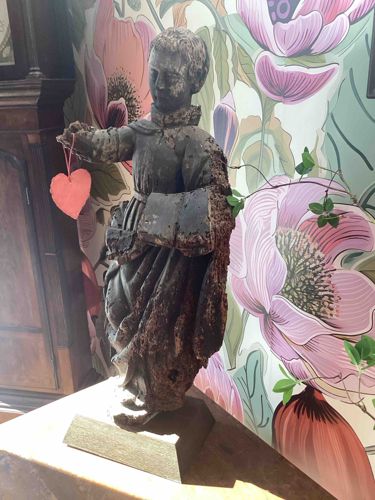
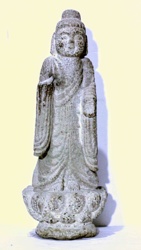
This is a hand-carved fruitwood or chestnut religious sculpture, likely depicting a young saint or Christ Child, originating from a Spanish ecclesiastical setting in the 16th century. The figure is masterfully rendered with a serene facial expression and naturalistic curly hair, standing in a classical pose. It features remnants of original polychrome and gesso finish over what appears to be a dark, aged patina on the wood. The craftsmanship is indicative of Late Renaissance or early Spanish Baroque style, characterized by the heavy, rhythmic folds of the drapery. The condition is reflective of its significant age; there is extensive woodworm damage (xylophagous exit holes) visible throughout the torso and the remains of the left arm, which has resulted in a friable, porous surface texture. The extremities exhibit historical wood loss, most notably to the left arm and lower hemline. The right arm is extended, currently holding a non-original red heart ornament. The figure is mounted on a modern wooden plinth for display. Despite the significant structural erosion and loss of the decorative outer layer, the inherent quality of the proportions and the fine carving of the face suggest it was commission-grade ecclesiastical art.
Estimated Value

$4,500 - $6,500

Basic Information

Category

Religious Art & Antiquities

Appraised On

February 2, 2026

Estimated Value

$4,500 - $6,500

Additional Details Provided By Owner

User Provided Information

Came from a church in Spain from the 1500s or older hand carved wood with worm holes.

Item Description

This is a hand-carved fruitwood or chestnut religious sculpture, likely depicting a young saint or Christ Child, originating from a Spanish ecclesiastical setting in the 16th century. The figure is masterfully rendered with a serene facial expression and naturalistic curly hair, standing in a classical pose. It features remnants of original polychrome and gesso finish over what appears to be a dark, aged patina on the wood. The craftsmanship is indicative of Late Renaissance or early Spanish Baroque style, characterized by the heavy, rhythmic folds of the drapery. The condition is reflective of its significant age; there is extensive woodworm damage (xylophagous exit holes) visible throughout the torso and the remains of the left arm, which has resulted in a friable, porous surface texture. The extremities exhibit historical wood loss, most notably to the left arm and lower hemline. The right arm is extended, currently holding a non-original red heart ornament. The figure is mounted on a modern wooden plinth for display. Despite the significant structural erosion and loss of the decorative outer layer, the inherent quality of the proportions and the fine carving of the face suggest it was commission-grade ecclesiastical art.
Get Your Items Appraised

Instant estimates of your treasures with AI-powered instant appraisals

Browse More Appraisals