These notes were written by the person who submitted this item. Appraiser.AI has not verified them, and the AI's identification and estimate may rely on them.
AI Estimated Value
Not an official valuation
$150-250
AI estimate as of December 16, 2025 · verify with a professional before acting
AI-Generated · Verify before acting
Everything on this page is generated by AI for informational purposes only. AI can make mistakes — the AI may misidentify items or misattribute them (artist, maker, brand, designer, origin, era). This is not an official valuation and should not be used for insurance, sale, tax, estate, legal, or lending purposes — or any decision requiring a certified appraisal. It is not an authoritative claim about any person, brand, or rights holder — do not share or rely on it as a factual statement about a third party. Always consult qualified professionals before making financial decisions.
This analysis also relies on unverified notes provided by the user, which may be incomplete or inaccurate and could affect the result.
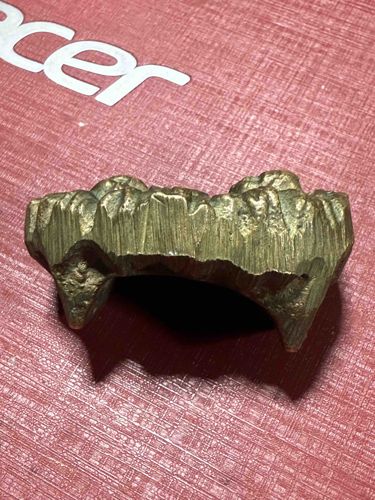
This item appears to be a sculptural component crafted from a brass or bronze-colored metal, intended to represent Baby Jesus in a manger. The overall form is rugged and abstract, suggesting a folk art or modern interpretation rather than a highly detailed classical rendering. The material exhibits a dull, non-reflective golden-brown hue, indicative of an aged or patinated brass or bronze alloy. The surface is characterized by a series of roughly parallel, vertical striations and uneven, almost chiseled textures, particularly visible on the 'sides' of the manger and the figures. The top portion, presumably depicting the infant Christ, comprises several rounded, indistinct forms, clustered together, with no discernible facial features or limbs. The 'manger' part is shaped like a trough or a concave block with a rough, textured interior and exterior. Two pointed, rudimentary supports extend downwards from the front, suggesting it is meant to stand or be affixed to a base. The edges are uneven and show a handcrafted quality. There are no obvious maker's marks, signatures, or stamps visible in the provided image. The condition appears stable with an aged patina consistent with its metallic composition. There are no visible signs of significant damage, repairs, or active deterioration, though the rough finish might obscure minor imperfections. The style points towards a rustic or abstract religious art piece, possibly dating from the mid-20th century to the present day due to its minimalist design.
AI Appraisal Report
I have examined the image of this Religious Diorama Component, 'Christ in a Manger,' which appears to be a sculptural piece made from a brass or bronze-colored metal. Based on visual assessment, the item exhibits a stable condition with an aged patina consistent with its metallic composition. The rugged, abstract form, characterized by striations and uneven textures, suggests a handcrafted quality and a folk art or modern aesthetic, rather than a classical, highly detailed rendering. The absence of discernible facial features or limbs on the 'Christ' figure reinforces this stylistic interpretation.
Authenticity, as a genuine handcrafted piece of metallic art, appears likely given its stylistic attributes. However, without a physical examination, I cannot definitively confirm the precise metal alloy (e.g., brass versus bronze, or even a plated base metal) or rule out potential mass production in this style. The lack of visible maker's marks is common for folk art or smaller artisanal creations, but it also limits authentication to a specific artist or workshop.
In terms of market conditions, this piece falls into the religious art and decorative folk art categories. Comparables would include abstract or minimalist religious sculptures in metal. Demand for such pieces is generally steady among collectors of religious iconography, folk art, and unique decorative items, but it is not considered rare. The abstract nature, while appealing to some, may limit its broader market appeal compared to more traditional depictions.
Factors impacting value include its appealing, albeit rough, artistic execution and stable condition. The lack of provenance or a known artist significantly impacts its value, as does the likely lack of precious metals. The primary value lies in its decorative and spiritual appeal as a unique, handcrafted item, rather than its material worth or historical significance.
For full authentication, a physical examination would be crucial to determine the specific metal composition through metallurgical analysis, assess the weight and fabrication methods, and thoroughly search for any obscured marks. Provenance documentation, detailing its origin and history, would also significantly enhance its value and confirm its authenticity as a specific artist's work if such records exist. Scientific testing could verify the age and specific alloy.