AI estimate as of July 13, 2025 · verify with a professional before acting
AI-Generated · Verify before acting
Everything on this page is generated by AI for informational purposes only. AI can make mistakes — the AI may misidentify items or misattribute them (artist, maker, brand, designer, origin, era). This is not an official valuation and should not be used for insurance, sale, tax, estate, legal, or lending purposes — or any decision requiring a certified appraisal. It is not an authoritative claim about any person, brand, or rights holder — do not share or rely on it as a factual statement about a third party. Always consult qualified professionals before making financial decisions.
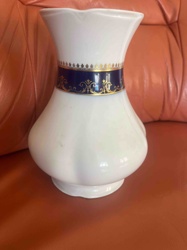
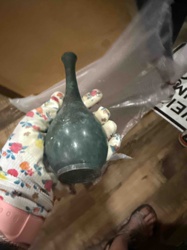
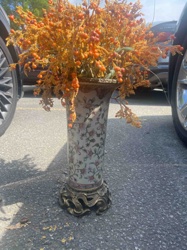
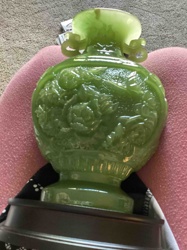
This is a small, vintage ceramic vase, specifically identified as a 'Drip Glaze' German piece, measuring approximately 12 cm in height. The vase exhibits a classic mid-century design with a flaring rim and a tapering body that narrows towards a distinct footed base. The most striking feature is its drip glaze application, characterized by a captivating color gradient. The top section of the vase features a dark, possibly charcoal or deep gray glaze with vertical streaks or drips, flowing into a creamy beige or off-white mid-section. Towards the base, the glaze transitions into a vibrant teal or turquoise hue before meeting a solid black foot. The surface appears glossy, and the glaze application suggests a somewhat organic or fluid aesthetic, typical of drip glaze techniques which often result in unique patterns. The rim of the vase shows an undulating or slightly scalloped edge, adding to its artisanal appeal. Given its specified origin as 'German Ceramic Vase' and 'Vintage' classification, it likely dates from the mid-20th century, possibly the 1950s or 1960s, a period known for innovative ceramic production in Germany. The overall condition appears 'Good' as indicated, with no readily visible chips, cracks, or significant damage, though closer inspection would be required to confirm. The craftsmanship suggests mass production with a decorative artistic finish, common for collectible art pottery of its era. No specific maker's mark or signature is visible in the provided image.
AI Appraisal Report
I have carefully examined the provided image of this small, vintage German Drip Glaze Ceramic Vase. Based on its visual characteristics, the condition appears to be good, with no obvious chips, cracks, or significant damage visible. The glossy surface and vibrant colors are well-preserved, suggesting careful handling over time. Authenticity as a German drip glaze piece from the mid-20th century (likely 1950s-60s) is highly probable given the style, glazes, and form, which are consistent with known German art pottery of that era.
In terms of market conditions, vintage mid-century ceramic art pottery generally sees steady demand, particularly for aesthetically pleasing and well-preserved examples. Drip glaze techniques, offering unique patterns, often appeal to collectors. While not exceptionally rare, unique color combinations and good condition command better prices. Comparables for smaller, unmarked German drip glaze vases in good condition typically range from $40 to $100. Factors limiting greater value include its small size (12 cm), the lack of a visible maker's mark or signature (which would significantly increase value if identifiable as a prominent studio or factory), and its likely mass-produced decorative nature rather than a unique artist piece.
The primary limitation of this appraisal is the reliance on images alone. For full authentication and a definitive assessment, an in-person examination would be crucial to physically inspect for hairline cracks, chips, crazing, or repairs not visible in photos. Physical inspection for impressed or painted maker's marks on the base is essential for provenance. Additionally, provenance documentation (e.g., purchase receipts, collection history) would strengthen its authenticity and value. Scientific testing is generally not required for this type of item unless there's doubt about materials or age, which is not indicated here.