AI Appraisal Estimate

AI-generated estimates · not official valuations

From the user

What was submitted

Photo and notes provided by the user — not generated by AI

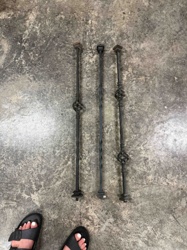
Submitted item photo
Submitted photo · June 13, 2026

User's notes

No additional notes provided.

AI analysis below

AI appraisal

AI analysis & estimate

AI-Generated · Verify before acting

Everything below is generated by AI for informational purposes only. AI can make mistakes — the AI may misidentify items or misattribute them (artist, maker, brand, designer, origin, era). This is not an official valuation and should not be used for insurance, sale, tax, estate, legal, or lending purposes — or any decision requiring a certified appraisal. It is not an authoritative claim about any person, brand, or rights holder — do not share or rely on it as a factual statement about a third party. Always consult qualified professionals before making financial decisions.

Read the full disclaimer

AI Identification

·Not independently authenticated·Verify before acting

Vintage Decorative Iron Scrollwork Brackets

Architectural Salvage & Hardware

AI Estimated Value

·Not an official valuation·Verify before acting

$450 - $650

As of June 13, 2026

AI Item Analysis

·AI can make mistakes·Verify before acting
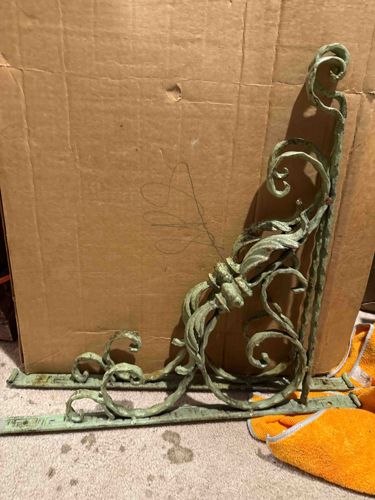
This is a pair of heavy-duty decorative wall or shelf brackets constructed from wrought iron. The design features intricate, fluid scrollwork and acanthus leaf-style motifs, characteristic of the Rococo Revival or Victorian period aesthetics. Physically, the brackets exhibit a textured, pale greenish-blue or seafoam patina over the underlying metal, which appears to be a multi-layered finish that has weathered over time. The construction is robust, with thick metal rods bent into ornate curves and welded to flat mounting bars on both the vertical and horizontal axes. Each mounting bar contains pre-drilled holes for secure installation. Notable features include the central leaf-like cluster and twisting metal details that suggest handcrafted assembly rather than a modern mass-produced casting. Regarding condition, there is visible surface wear, including some chipping of the paint, mild oxidation or rust staining in deeper recessed areas, and general grit consistent with age and outdoor exposure or long-term storage in a non-climate-controlled environment. There are no visible maker's marks or signatures, which is common for architectural hardware of this type from the early-to-mid 20th century. The craftsmanship is of high quality, demonstrating significant structural integrity alongside its ornamental appeal.
AI Appraisal Report

·AI can make mistakes·Verify before acting
Based on my visual examination of these wrought iron brackets, I identify them as high-quality architectural salvage consistent with early 20th-century craftsmanship. The intricate scrollwork and acanthus leaf motifs suggest a Victorian or Rococo Revival influence. The construction—utilizing heavy-gauge iron rods rather than brittle cast iron—indicates a superior load-bearing capacity and durability. The 'seafoam' patina appears to be a multi-layered finish with authentic oxidation in the recesses, which is highly desirable in the current 'shabby chic' and industrial architectural markets. Market demand for original architectural ironwork remains steady, particularly for matched pairs of this scale and complexity. Comparable pairs from the 1920s or 1930s typically sell within the $400 to $700 range in high-end antique markets. The lack of maker's marks is typical for this category and does not significantly detract from value, as the quality of the welds and hand-bent curves speaks to its professional manufacture. However, a definitive appraisal is limited by the digital nature of this inspection. Authenticity is assessed based on visual weathering and construction techniques. To confirm this isn't a modern distressed reproduction, a physical inspection is required to check the 'ring' of the metal, the specific weight, and the chemical composition of the paint layers (such as lead-based undercoats common in older pieces). Verification through provenance—such as historical photographs or documentation of the building from which they were salvaged—would further solidify and potentially increase the valuation. Current value is based on the items' utility as functional architectural hardware and their aesthetic appeal as decorative objects.

Get your items appraised

Instant estimates of your treasures with AI-powered appraisals

Browse More Appraisals