AI estimate as of September 26, 2025 · verify with a professional before acting
AI-Generated · Verify before acting
Everything on this page is generated by AI for informational purposes only. AI can make mistakes — the AI may misidentify items or misattribute them (artist, maker, brand, designer, origin, era). This is not an official valuation and should not be used for insurance, sale, tax, estate, legal, or lending purposes — or any decision requiring a certified appraisal. It is not an authoritative claim about any person, brand, or rights holder — do not share or rely on it as a factual statement about a third party. Always consult qualified professionals before making financial decisions.
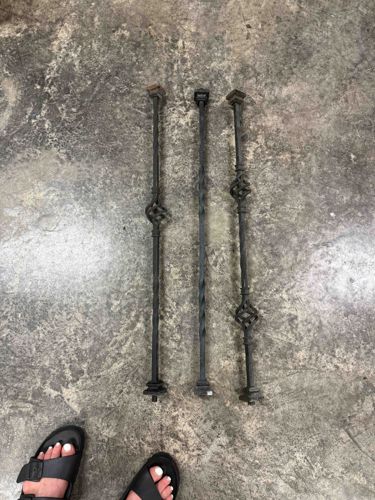
This lot consists of three individual forged iron balusters, likely intended for use in a staircase railing or decorative grate. Each baluster is crafted from dark-colored, possibly black, iron with a matte finish, suggesting a period finish or a deliberately aged appearance. They exhibit varying levels of decorative forging. The baluster on the left features a single, prominent basket-weave or 'birdcage' twist section in its upper portion, created by twisting four square rods together. The baluster in the center is a simpler, yet still artisanal, design with a long, continuous twisted section along its shaft, suggesting it began as a square stock and was heated and twisted. The baluster on the right is similar to the first, showcasing a single basket-weave twist, though it appears slightly more elongated or narrower in its twisted section compared to the leftmost one. All three balusters terminate in square sections at both ends, with the bottom ends appearing to have some form of mounting hardware or a more substantial, flattened square base, possibly for welding or bolting into place. The top ends also have square cross-sections, ready for attachment to a handrail or other structural elements. The visible condition suggests some surface wear, minor rust, and a generally weathered patina consistent with age and previous use or outdoor storage. No specific maker's marks or signatures are discernible from the image. The craftsmanship points to traditional blacksmithing techniques, likely late 19th or early 20th century, or modern reproductions aiming for an antique aesthetic. Their robust construction and decorative elements indicate a focus on both functionality and aesthetic appeal, classic indicators of quality in architectural ironwork.
AI Appraisal Report
Based on my visual examination of the provided image, this lot of three forged iron balusters appears to be authentic examples of architectural salvage. Their dark, matte finish, combined with visible surface wear and minor rust, suggests age and prior use or exposure to elements, consistent with salvaged items. The craftsmanship, particularly the basket-weave and continuous twist sections, points to traditional blacksmithing techniques. While they could be late 19th or early 20th century, modern reproductions aiming for an antique aesthetic cannot be entirely ruled out without further inspection.
Market conditions for architectural ironwork like this lean towards steady, driven by both restoration projects and new construction seeking a vintage look. Comparable items in good, but unrestored, condition typically sell individually for $50-$100 depending on complexity and origin. The three diverse designs in this lot add to their appeal for a buyer seeking variety or a small matching set. Demand is moderate, appealing to specific niches: restorers, architects, and designers.
Factors impacting value include their condition (which is fair, showing age but structurally sound), and the lack of a known provenance. Rarity is not particularly high for individual balusters, but a matching set of three, even with varied designs, adds some desirability.
Limitations in authenticity verification are significant. Without an in-person examination, I cannot definitively ascertain the age or true origin. A physical inspection would allow me to check for specific forging marks, assess the metal’s composition, and better gauge the depth of patination and rust – elements crucial for confirming historical authenticity versus modern faux-aging. Provenance documentation would be ideal to establish a verifiable history. Given these limitations, and considering the condition and current market for similar architectural salvage, I estimate the value for this lot to be in the range of $150-250.