AI Appraisal Estimate

AI-generated estimates · not official valuations

From the user

What was submitted

Photo and notes provided by the user — not generated by AI

Submitted item photo
Submitted photo · June 25, 2026

User's notes

No additional notes provided.

AI analysis below

AI appraisal

AI analysis & estimate

AI-Generated · Verify before acting

Everything below is generated by AI for informational purposes only. AI can make mistakes — the AI may misidentify items or misattribute them (artist, maker, brand, designer, origin, era). This is not an official valuation and should not be used for insurance, sale, tax, estate, legal, or lending purposes — or any decision requiring a certified appraisal. It is not an authoritative claim about any person, brand, or rights holder — do not share or rely on it as a factual statement about a third party. Always consult qualified professionals before making financial decisions.

Read the full disclaimer

AI Identification

·Not independently authenticated·Verify before acting

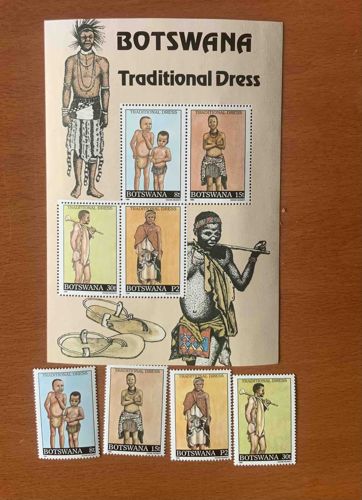
1982 Botswana Traditional Dress Souvenir Sheet and Stamp Set

Philately / Postage Stamps

AI Estimated Value

·Not an official valuation·Verify before acting

$10.00 - $15.00

As of June 25, 2026

AI Item Analysis

·AI can make mistakes·Verify before acting
This is a philatelic collection from Botswana consisting of a souvenir sheet and four individual companion stamps from the 'Traditional Dress' series, likely issued in 1982. The souvenir sheet measures approximately 10x15cm and features 4 perforated stamps (8t, 15t, 30t, and P2 denominations) integrated into a large pictorial background. The artwork depicts various members of the Batswana people in indigenous attire, including a large standing figure on the left in ceremonial dress and a seated figure on the right. Below the center stamps, there is an illustration of traditional handmade leather sandals. The stamps use a polychrome printing process with a soft, earth-toned color palette of tans, ochre, and pale blue. Each stamp is labeled 'TRADITIONAL DRESS' at the top and 'BOTSWANA' at the bottom. The condition appears to be mint (unused) and never hinged (NH), with crisp perforations and no visible signs of foxing, sunlight fading, or creasing. The quality of the lithography is high, showing fine line work in the skeletal and muscular details of the figures. This set represents a cultural heritage theme, common in African post-colonial philately. The denominations indicate they were intended for various postal rates: domestic, surface mail, and airmail. The stamps are aesthetically characteristic of late 20th-century African stamp design, focusing on ethnography and national identity.

AI Appraisal Report

·AI can make mistakes·Verify before acting
I have completed a visual assessment of the 1982 Botswana 'Traditional Dress' souvenir sheet and the four accompanying loose stamps. Based on the provided imagery, the set appears to be in Mint Never Hinged (MNH) condition. The perforations are crisp and uniform, the colors remain vibrant with no evidence of UV fading or foxing, and the gum (though not directly visible) is assumed to be original and undisturbed given the pristine margins. This issue (Scott #294-297 and #298 for the souvenir sheet) is a classic example of late-20th-century African ethnographic philately. While the artwork is of high quality and the cultural subject matter remains popular among thematic collectors (costumes/people), these stamps were produced in relatively large quantities for the international philatelic market. Market demand for this specific era of Botswana postal history is steady but high-volume, meaning rarity is low. Valuation is based on recent 'sold' entries in philatelic databases and retail catalogs. The primary value lies in the souvenir sheet, which typically retails for $5–$8, while the individual stamps contribute the remainder. Important Note: This appraisal is based strictly on digital images. Without an in-person examination, I cannot verify the presence of 'sweating' (minor gum disturbances), regumming, or microscopic paper thins. Full authentication would require a physical inspection under long-wave UV light to check for paper fluorescence and a tactile check of the gum's texture. Provenance documentation from a reputable philatelic society would support authenticity, though the low market value generally precludes the need for formal certification.

Get your items appraised

Instant estimates of your treasures with AI-powered appraisals

Browse More Appraisals