These notes were written by the person who submitted this item. Appraiser.AI has not verified them, and the AI's identification and estimate may rely on them.
AI Estimated Value
Not an official valuation
$5 - $15
AI estimate as of November 10, 2025 · verify with a professional before acting
AI-Generated · Verify before acting
Everything on this page is generated by AI for informational purposes only. AI can make mistakes — the AI may misidentify items or misattribute them (artist, maker, brand, designer, origin, era). This is not an official valuation and should not be used for insurance, sale, tax, estate, legal, or lending purposes — or any decision requiring a certified appraisal. It is not an authoritative claim about any person, brand, or rights holder — do not share or rely on it as a factual statement about a third party. Always consult qualified professionals before making financial decisions.
This analysis also relies on unverified notes provided by the user, which may be incomplete or inaccurate and could affect the result.
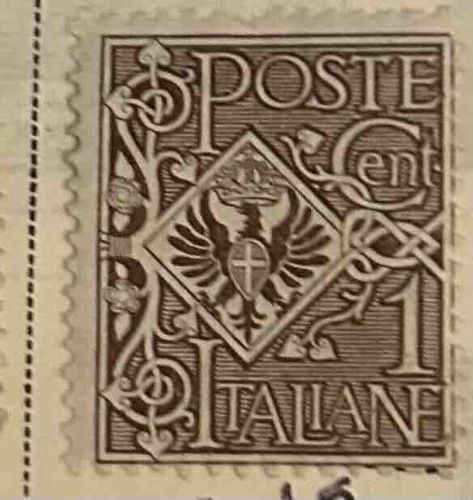
This is a perforated postage stamp from Italy, likely dating from the late 19th or early 20th century, given its aesthetic and denomination. The stamp features a central diamond-shaped escutcheon with a crowned eagle, wings spread, clutching a shield or emblem that appears to bear a cross. This heraldry is characteristic of Italian royal or governmental symbols of the period. Surrounding the central motif, and forming the primary frame of the stamp, is intricate, dark brown line work against a lighter background, creating a decorative, almost Art Nouveau or Neoclassical border with stylized floral and scroll elements. At the top, the word "POSTE" is prominently displayed, with "Cent" in smaller script to the right and the numeral "1" at the bottom right. The word "ITALIANE" is visible along the bottom, vertically aligned below "POSTE." The stamp itself is rectangular, with clear perforations visible along the left and top edges, suggesting it was part of a larger sheet. The color appears to be a monochromatic brown or sepia tone, typical of stamps from this era. The condition shows some minor corner rounding and possibly slight discoloration consistent with age, but no major tears, creases, or cancellations are discernible from the image. The intricate details of the design are still well-preserved, indicating good printing quality for its time. The impression is sharp, and the fine lines of the decorative elements are distinct.
AI Appraisal Report
Based on my visual examination of the provided image, this appears to be an Italian Post 1 Centesimi stamp, likely from the Umberto I period (1879-1900), specifically from the 'Umberto I with Crown' series. The design elements, including the crowned eagle and heraldry, are consistent with this era. The monochromatic brown/sepia tone and intricate line work are also typical of stamps from this period.
In terms of condition, the stamp shows minor corner rounding and some discoloration consistent with its age, but no apparent major tears or creases, and the perforations appear intact on the visible edges. The impression is sharp, suggesting good printing quality. This condition would be considered fine to very fine for a stamp of this age. Authenticity based on visual inspection alone is limited; a definitive determination requires physical examination to assess paper type, watermarks (if any), printing methods, and gum condition. Provenance documentation could also support authentication.
Market conditions for Italian stamps of this common denomination from the late 19th century are generally stable. While attractive, the 1 Centesimi denomination was produced in very large quantities, making it relatively common. Demand is consistent among general stamp collectors, but it does not typically attract high-end collectors unless it possesses rare varieties, plate flaws, or exceptional cancellations. Without such distinguishing features, the rarity is low.
Factors impacting value include the common denomination and generally good, but not exceptional, condition. The absence of a cancellation mark can sometimes be preferable, but for common items, it doesn't significantly elevate value. To fully verify authenticity and assess any potential varieties, a physical inspection under magnification, including examination of the reverse side for gum and potential watermarks, would be essential.