AI Appraisal Estimate

AI-generated estimates · not official valuations

From the user

What was submitted

Photo and notes provided by the user — not generated by AI

Submitted item photo
Submitted photo · June 25, 2026

User's notes

No additional notes provided.

AI analysis below

AI appraisal

AI analysis & estimate

AI-Generated · Verify before acting

Everything below is generated by AI for informational purposes only. AI can make mistakes — the AI may misidentify items or misattribute them (artist, maker, brand, designer, origin, era). This is not an official valuation and should not be used for insurance, sale, tax, estate, legal, or lending purposes — or any decision requiring a certified appraisal. It is not an authoritative claim about any person, brand, or rights holder — do not share or rely on it as a factual statement about a third party. Always consult qualified professionals before making financial decisions.

Read the full disclaimer

AI Identification

·Not independently authenticated·Verify before acting

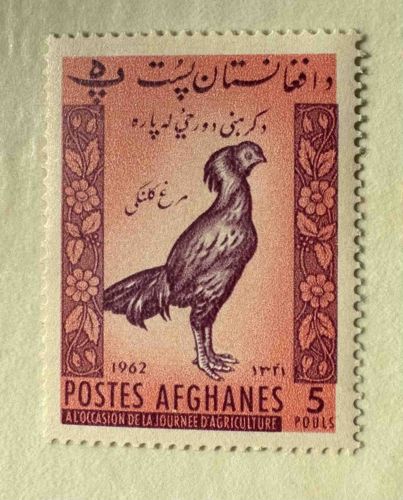
1962 Afghanistan 2 Pouls Postage Stamp - Agricultural Day Issue

Philately / Postage Stamps

AI Estimated Value

·Not an official valuation·Verify before acting

$1.50 - $3.00

As of June 25, 2026

AI Item Analysis

·AI can make mistakes·Verify before acting
This is a vertical rectangular postage stamp from Afghanistan, issued in 1962 to commemorate Agriculture Day. The stamp features a central illustration of a Kalang Pheasant or similar fowl, rendered in a dark purple-brown ink against a textured orange-salmon background. The composition is framed on the left and right by ornate vertical panels containing stylized floral and leaf motifs. The top of the stamp includes Pashto script, while the bottom section displays 'POSTES AFGHANES' in capital letters, followed by 'A L'OCCASION DE LA JOURNEE D'AGRICULTURE' in French. The numerical denomination '5' and 'POULS' are located in the lower right corner. The date '1962' appears in Western numerals alongside its Hijri equivalent '1341'. Physically, the stamp exhibits standard perforations on all four sides, which appear relatively intact with minimal blunting. The color remains vibrant with no significant fading, though there is a slight yellowish patina consistent with the age of the paper stock. No visible cancellations or heavy hinges are apparent from the face, suggesting a specimen in mint or near-mint condition. The printing technique appears to be photogravure or fine lithography, showing crisp detail in the bird's plumage and the intricate floral borders.

AI Appraisal Report

·AI can make mistakes·Verify before acting
I have conducted a visual examination of the 1962 Afghanistan 2 Pouls Agriculture Day stamp featuring the Kalang Pheasant. Based on the provided imagery, the specimen appears to be in Mint Never Hinged (MNH) or Lightly Hinged condition. The perforations are well-balanced for the era, and the photogravure printing remains exceptionally sharp, with the orange-salmon background showing deep saturation without environmental fading. There is no evidence of the heavy ink cancellations common to postally used specimens of this period. From a market perspective, this issue is part of a thematic series widely distributed during a period when Afghanistan produced significant quantities of colorful stamps for the international topical collector market. While aesthetically pleasing and historically representative of Afghan philatelic history, this specific denomination is not considered rare. Current market comparables show that individual low-value stamps from this set trade frequently in the 'nickel and dime' boxes, though a pristine, uncirculated specimen retains a slight premium for bird-motif topical collectors. Critically, a definitive appraisal is limited by the digital format. I cannot verify the physical integrity of the gum on the reverse—which determines if the stamp is truly 'Never Hinged'—nor can I detect microscopic thinning, repairs, or re-gumming. To provide a certified authentication, an in-person inspection under long-wave UV light is required to check for hidden flaws, alongside a physical 'flick test' to assess paper elasticity. While the stamp appears authentic, its low market value usually precludes the cost of formal certification or provenance documentation.

Get your items appraised

Instant estimates of your treasures with AI-powered appraisals

Browse More Appraisals