AI estimate as of December 15, 2025 · verify with a professional before acting
AI-Generated · Verify before acting
Everything on this page is generated by AI for informational purposes only. AI can make mistakes — the AI may misidentify items or misattribute them (artist, maker, brand, designer, origin, era). This is not an official valuation and should not be used for insurance, sale, tax, estate, legal, or lending purposes — or any decision requiring a certified appraisal. It is not an authoritative claim about any person, brand, or rights holder — do not share or rely on it as a factual statement about a third party. Always consult qualified professionals before making financial decisions.
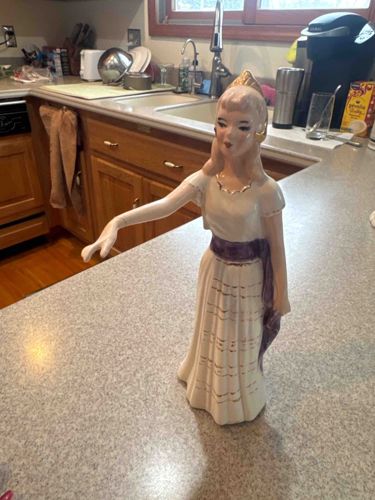
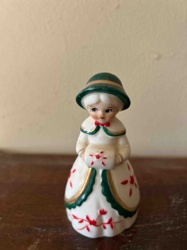
This item is a ceramic figurine depicting a stylized woman in an elegant pose, likely dating from the mid-20th century, possibly influenced by Art Deco aesthetics given its streamlined form and decorative details. The figurine stands approximately 12-15 inches tall, though exact dimensions are not provided. It is primarily made of glazed ceramic or porcelain, with a smooth, glossy finish. The figure is depicted with light blonde or pale pinkish hair, styled in a bob with a golden tiara-like accessory or bun at the back of the head. Her facial features are delicately painted: rosy cheeks, red lips, and dark, slender eyebrows. She wears a golden necklace and what appears to be golden earrings. Her attire consists of a white short-sleeved top with a golden trim around the collar and sleeves, paired with a long, flowing cream-colored skirt that features horizontal ridged or pleated lines, accented with gold details to suggest fabric folds. A dark purple or deep plum colored sash is cinched around her waist, extending to her right side and draping down. Her left arm is extended outwards, slightly bent at the elbow, with the hand open in a graceful gesture. The construction appears to be a single-piece mold, with painted details applied afterwards. No visible cracks, chips, or significant wear are immediately apparent on the surface, suggesting good preservation or careful handling. The craftsmanship appears to be of moderate quality, with commercially produced characteristics. There are no discernible maker's marks or signatures visible in the provided image. The figurine's pose and attire suggest a classical or theatrical inspiration, possibly a dancer or a noblewoman.
AI Appraisal Report
Based on my visual examination of the provided image, I assess this Art Deco style ceramic figurine of a woman. The condition appears to be good; I do not observe any immediate cracks, chips, or significant wear. The smooth, glossy finish is consistent with a well-preserved glazed ceramic piece. Authenticity is challenging to ascertain solely from an image, but the style, craftsmanship, and decorative details are consistent with commercially produced ceramic figurines from the mid-20th century, likely influenced by the Art Deco aesthetic.
In terms of market conditions, similar mass-produced ceramic figurines from this era, even those with elegant styling, generally do not command high prices unless they are from a renowned manufacturer or an especially rare model. Comparables in the secondary market, such as online auctions and vintage marketplaces, typically show these types of pieces selling in the $50-$150 range. The absence of a discernible maker's mark significantly impacts value, as it prevents attribution to a specific, potentially desirable, manufacturer.
Demand for decorative ceramic figurines of this nature is moderate; there's a niche market of collectors who appreciate the Art Deco aesthetic or vintage ceramic art, but it's not a highly sought-after collectible category. Rarity is difficult to determine without knowledge of production numbers, but the commercially produced characteristics suggest it wasn't exceedingly rare.
Key factors limiting the value are the lack of a maker's mark, confirming its origin and potential attribution, and the general market for decorative ceramicware. For full authentication and a more precise valuation, an in-person examination would be crucial. This would allow me to inspect the base for hidden marks, assess the true quality of the ceramic and glaze, and check for any repairs or restorations not visible in photographs. Provenance documentation, if available, linking the piece to a specific artist, factory, or notable collection, would also hugely impact its value. Scientific testing for material composition is typically not performed on items in this price range but could confirm the ceramic type if needed for high-end pieces.