AI Appraisal Estimate

AI-generated estimates · not official valuations

From the user

What was submitted

Photo and notes provided by the user — not generated by AI

Submitted item photo
Submitted photo · June 23, 2026

User's notes

No additional notes provided.

AI analysis below

AI appraisal

AI analysis & estimate

AI-Generated · Verify before acting

Everything below is generated by AI for informational purposes only. AI can make mistakes — the AI may misidentify items or misattribute them (artist, maker, brand, designer, origin, era). This is not an official valuation and should not be used for insurance, sale, tax, estate, legal, or lending purposes — or any decision requiring a certified appraisal. It is not an authoritative claim about any person, brand, or rights holder — do not share or rely on it as a factual statement about a third party. Always consult qualified professionals before making financial decisions.

Read the full disclaimer

AI Identification

·Not independently authenticated·Verify before acting

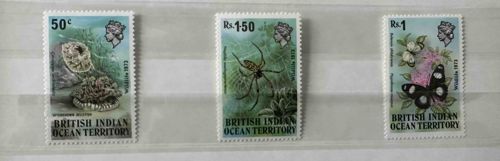
British Indian Ocean Territory 1973 Wildlife Postage Stamps

Philately / Postage Stamps

AI Estimated Value

·Not an official valuation·Verify before acting

$5 - $10

As of June 23, 2026

AI Item Analysis

·AI can make mistakes·Verify before acting
This is a collection of three commemorative postage stamps from the British Indian Ocean Territory (BIOT), issued in 1973 as part of a wildlife definitive or special series. The stamps feature vertical orientations with perforated edges, printed on standard gummed stamp paper. Each stamp depicts different local fauna: the 50c stamp showcases an Upside-Down Jellyfish (Cassiopea andromeda), the Rs. 1.50 stamp features a spider (Nephila madagascariensis) on its web, and the Rs. 1 stamp illustrates a butterfly (Hypolimnas misippus) on flora. In the upper right corner of each stamp is the profile of Queen Elizabeth II in silver or grey, indicating the territory's status as a British Overseas Territory. The text 'BRITISH INDIAN OCEAN TERRITORY' is printed clearly at the bottom in a bold, black serif font. The printing quality is high, utilizing multi-color offset lithography with a distinct green-blue wash in the backgrounds. The stamps appear to be in Mint Never Hinged (MNH) or fine used condition, housed within a clear protective plastic philatelic strip. No visible foxing, creases, or heavy cancellations are present, preserving the vibrant greens, browns, and blacks of the biological illustrations. The year '1973' is vertically printed on the right side of each illustration, confirming the issue date.

AI Appraisal Report

·AI can make mistakes·Verify before acting
Upon examining this partial set of three British Indian Ocean Territory (BIOT) stamps from the 1973 Wildlife series, I have determined the collection includes the 50c (Upside-Down Jellyfish), Rs 1 (Butterfly), and Rs 1.50 (Spider) denominations. These stamps, printed via offset lithography, feature the requisite Queen Elizabeth II profile and the distinctive greenish-blue background wash characteristic of this specific issue. The condition appears to be Mint Never Hinged (MNH) or lightly hinged, as the colors are vibrant and there are no visible cancellation marks, creases, or foxing on the face. The perforations look clean and centered, though precise centering measurements require physical tools. This 1973 definitive set was issued during a period when BIOT stamps were produced in relatively high quantities for the collector market, meaning they are not considered rare. Full sets of this issue (usually comprising 12-15 values) typically trade for $40-$60; however, this is a broken set containing only high values but missing typical key values or the complete run. While these are beautiful examples of thematic philately combining royalty and wildlife, demand remains modest. They are generally sought by topical collectors (fauna) or British Commonwealth specialists. My valuation reflects retail pricing for single replacement stamps or a partial set. Please note that without physical inspection, I cannot confirm the state of the gum on the reverse (original vs. regummed) or check for watermarks, which are essential for absolute grading. Provenance is less critical here given the low individual value, but a physical check would confirm the absence of hidden thins or paper faults.

Get your items appraised

Instant estimates of your treasures with AI-powered appraisals

Browse More Appraisals