These notes were written by the person who submitted this item. Appraiser.AI has not verified them, and the AI's identification and estimate may rely on them.
AI Estimated Value
Not an official valuation
$100-250
AI estimate as of August 16, 2025 · verify with a professional before acting
AI-Generated · Verify before acting
Everything on this page is generated by AI for informational purposes only. AI can make mistakes — the AI may misidentify items or misattribute them (artist, maker, brand, designer, origin, era). This is not an official valuation and should not be used for insurance, sale, tax, estate, legal, or lending purposes — or any decision requiring a certified appraisal. It is not an authoritative claim about any person, brand, or rights holder — do not share or rely on it as a factual statement about a third party. Always consult qualified professionals before making financial decisions.
This analysis also relies on unverified notes provided by the user, which may be incomplete or inaccurate and could affect the result.
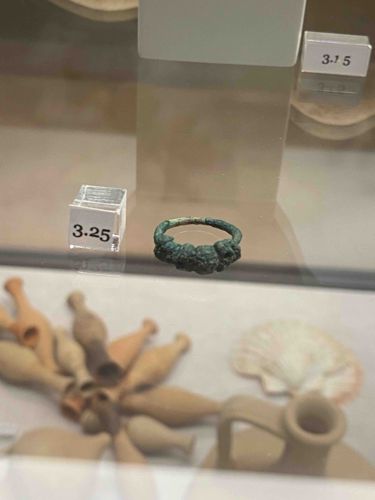
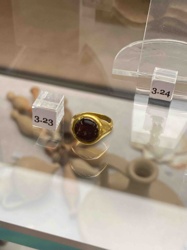
This item is an ancient bronze ring, likely dating from antiquity given its material and the significant patina evident. The ring is relatively small, suggesting it was worn on a finger. It is crafted from bronze, now heavily encrusted with a thick, greenish-blue patina, characteristic of long-term exposure to certain environmental conditions, possibly marine given the other artifacts visible in the display (miniature amphorae and what appears to be a seashell). This heavy oxidization obscures much of the original surface detail, but the overall form indicates a relatively robust construction. The band of the ring appears to be somewhat uneven or textured, possibly due to corrosion or an original design element that incorporated a rough, artisanal finish, or even a twisted/braided motif. The most notable feature is the raised, somewhat abstract or eroded-looking element on the bezel or top portion of the ring, which might have originally depicted a figure, a symbol, or an intricate pattern. However, the extreme corrosion makes precise identification impossible from the image alone. There are no discernible maker's marks or clear decorative carvings visible through the patina. The condition is consistent with archaeological finds, showing significant material degradation but retaining its structural integrity as a ring. The quality of craftsmanship is difficult to assess precisely due to the heavy patina, but it appears to be a functional and perhaps decorative piece from its era.
AI Appraisal Report
Upon examining the provided image and description of this ancient bronze ring, I've assessed its condition as consistent with archaeological recovery, exhibiting significant patination and corrosion. This heavy greenish-blue encrustation, while obscuring detail, is indicative of genuine age and long-term environmental exposure, lending authenticity to its antique claim. Its structural integrity remains, despite the surface degradation. Without direct physical examination, verifying absolute authenticity is limited. A key limitation is distinguishing genuine ancient patination from artificially aged pieces. I cannot definitively assess the original craftsmanship or the abstract element on the bezel due to the corrosion. For full authentication, I'd require in-person examination to study the patina layers, material composition analysis (e.g., XRF), and microscopic examination for tool marks and wear patterns. Provenance documentation, such as excavation records or established collection history, would also significantly enhance authenticity and value.
In terms of market conditions, ancient bronze rings, especially those with unclear decorative elements or specific historical context, typically fall into a lower value bracket compared to rings with recognizable symbols, inscriptions, or precious materials. Demand exists among collectors of ancient artifacts, but rarity varies. While it is certainly an ancient piece, its common material and obscured details reduce its overall rarity in the broader archaeological market. Without clear artistic or historical significance, its value is primarily as an authentic artifact of antiquity. Factors significantly impacting value include the heavily obscured details and the lack of specific provenance. If the raised element could be identified as a deity, specific symbol, or if it had a documented archaeological context, its value would notably increase.
Considering these factors, particularly the commonality of bronze, the obscured details due to heavy patination, and the need for further authentication beyond visual assessment, I place this ring in a modest value range.