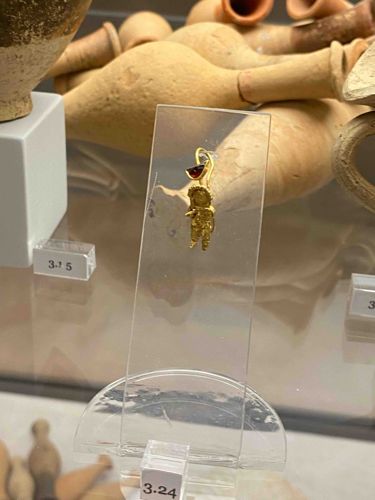
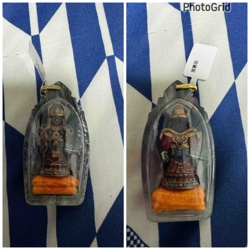
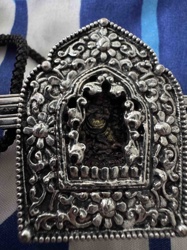
Ancient golden earring with gemstone in the top, and main part in the shape of a baby
These notes were written by the person who submitted this item. Appraiser.AI has not verified them, and the AI's identification and estimate may rely on them.
AI Estimated Value
Not an official valuation
$6,000 - $9,000
AI estimate as of August 16, 2025 · verify with a professional before acting
AI-Generated · Verify before acting
Everything on this page is generated by AI for informational purposes only. AI can make mistakes — the AI may misidentify items or misattribute them (artist, maker, brand, designer, origin, era). This is not an official valuation and should not be used for insurance, sale, tax, estate, legal, or lending purposes — or any decision requiring a certified appraisal. It is not an authoritative claim about any person, brand, or rights holder — do not share or rely on it as a factual statement about a third party. Always consult qualified professionals before making financial decisions.
This analysis also relies on unverified notes provided by the user, which may be incomplete or inaccurate and could affect the result.
This appears to be an ancient gold earring or pendant, possibly an amulet, featuring a stylized human figure, likely a baby or putto. The primary material is gold, evidenced by its distinct yellowish, metallic luster and apparent resistance to significant corrosion, suggesting high purity. Perched above the figure's head is a singular, dark red gemstone, likely a garnet or deep red glass, set within a gold bezel or simple mount. The design incorporates a loop at the very top, indicative of its function as an earring or a suspended charm. The overall size appears small, consistent with a personal adornment, probably no more than an inch or two in height. The craftsmanship suggests a cast or hammered technique, given the somewhat rounded and simplified features of the figure. Details such as facial features or intricate clothing are not distinctly visible, implying an abstract or heavily stylized representation, which is common in ancient artifacts. The condition seems remarkably well-preserved for its presumed age, showing minimal signs of significant wear or surface damage, beyond natural patina or slight surface irregularities inherent to ancient manufacturing. There are no readily visible maker's marks or inscriptions from the photographic evidence. The style, particularly the gold material and the motif of a depicted human form, points toward a classical or ancient Near Eastern origin, possibly Roman, Hellenistic, or Egyptian, dating back several centuries BCE to early CE. The simplicity of form combined with the use of precious materials suggests it was an item of value and perhaps symbolic significance. Its quality of craftsmanship is robust, designed to last, consistent with ancient luxury items.
AI Appraisal Report
Upon my virtual examination of the 'Ancient Gold Earring/Pendant with Garnet and Baby Figure,' I can offer a preliminary appraisal. Based on the provided images, the item appears to be crafted from high-purity gold, exhibiting typical luster and minimal corrosion, indicative of a precious metal and potentially significant age. The single dark red gemstone, likely a garnet, is set in a simple bezel. The stylized baby figure, a common motif in ancient art (e.g., Erotes, putti), suggests a classical, Hellenistic, or Roman provenance, dating potentially from several centuries BCE to early CE. The craftsmanship, though simplistic, appears robust, consistent with ancient luxury items designed for durability.
In terms of condition, it appears remarkably well-preserved for its presumed antiquity, showing appropriate patina and no obvious signs of significant damage or repair from the visual evidence. This excellent state of preservation significantly enhances its appeal.
However, it is crucial to state that this appraisal is based solely on photographic evidence. Definitive authentication of ancient artifacts requires in-person examination to assess specific manufacturing techniques, material composition, wear patterns, and microscopic details. Furthermore, scientific testing, such as X-ray fluorescence (XRF) for metal analysis or Raman spectroscopy for gemstone identification, would provide certainty regarding materials. Crucially, a robust provenance – a documented history of ownership – is paramount for authenticating ancient artifacts and significantly impacts value. Without physical inspection and provenance documentation, I cannot definitively verify its authenticity. Due to this limitation, an in-person expert examination is strongly recommended to confirm period, origin, and authenticity.
Considering market demand for genuine ancient jewelry and amulets, pieces with recognizable motifs and in good condition are highly sought after by collectors and institutions. Comparables would include similar gold pieces from the Roman or Hellenistic periods featuring figurative elements. The rarity of such well-preserved smaller artifacts also contributes to their value. If definitively authentic, its aesthetic appeal and historical significance would command a strong market price.
Factors significantly impacting value include confirmed authenticity, precise dating, specific origin (e.g., Roman vs. Egyptian), and the actual purity of the gold. Conversely, any indication of modern replication or significant repair would drastically reduce its worth.