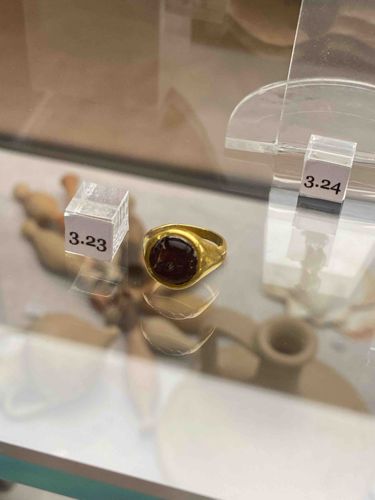
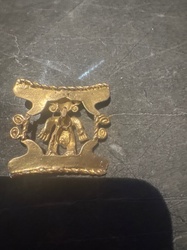
Anello digitale con corniola, sulla quale è incisa una civetta
These notes were written by the person who submitted this item. Appraiser.AI has not verified them, and the AI's identification and estimate may rely on them.
AI Estimated Value
Not an official valuation
$8,000 - $12,000
AI estimate as of August 16, 2025 · verify with a professional before acting
AI-Generated · Verify before acting
Everything on this page is generated by AI for informational purposes only. AI can make mistakes — the AI may misidentify items or misattribute them (artist, maker, brand, designer, origin, era). This is not an official valuation and should not be used for insurance, sale, tax, estate, legal, or lending purposes — or any decision requiring a certified appraisal. It is not an authoritative claim about any person, brand, or rights holder — do not share or rely on it as a factual statement about a third party. Always consult qualified professionals before making financial decisions.
This analysis also relies on unverified notes provided by the user, which may be incomplete or inaccurate and could affect the result.
This item is an ancient gold ring, likely a signet ring, featuring an oval-shaped carnelian intaglio set within a substantial gold bezel. The gold band appears to be of a thick, simple, and rounded design, characteristic of ancient jewelry craftsmanship. The metal exhibits an aged patina, suggesting significant age and perhaps some natural surface wear consistent with historical artifacts. Despite the age, the gold maintains a rich, warm yellow hue. The carnelian gemstone, a semi-translucent reddish-brown to orange-red stone, is securely set and appears to be in good condition, without visible chips or cracks. Upon closer inspection, an engraving of an owl is discernible on the surface of the carnelian. This carving, possibly a depiction of an an 'intaglio' (an image incised into the surface), is a key feature and suggests the ring may have served as a seal or held symbolic significance. The craftsmanship of the gold work appears solid and well-executed, indicating a skilled artisan. There are no obvious signs of recent repair or significant damage, though minor surface abrasions or wear consistent with its age are present. The overall aesthetic points to an item from antiquity, possibly Roman, Greek, or another ancient Mediterranean culture. Its function could have been personal ornamentation, a symbol of status, or a practical sealing device.
AI Appraisal Report
Based on my visual examination of the provided image and the owner's description, this ancient gold ring with a carnelian intaglio depicting an owl appears to be a genuine artifact of significant historical and artistic merit. The substantial gold band, thick bezel, and the aged patina are consistent with ancient craftsmanship. The carnelian intaglio, with its discernible owl engraving, seems well-preserved and securely set, showing no obvious chips or cracks. The overall condition suggests careful handling over millennia, with typical surface wear and abrasions expected for an item of this age.
Authenticity: While the ring exhibits characteristics typical of ancient Roman or Greek jewelry, a definitive authentication cannot be made from visual assessment alone. The term 'Anello digitale con corniola' confirms the owner's understanding of the piece. To fully authenticate, an in-person examination by an ancient jewelry specialist is crucial. This would involve a detailed analysis of the gold's alloy, the carving technique of the intaglio, and any microscopic tool marks. Furthermore, provenance documentation (history of ownership) is paramount. Scientific testing, such as XRF analysis for gold composition and Raman spectroscopy for the carnelian, would provide invaluable data.
Market Conditions and Rarity: Ancient rings with well-preserved intaglios, especially those depicting recognizable motifs like owls (often associated with Minerva/Athena), are highly sought after by collectors of antiquities. The market for such pieces is robust, driven by their historical significance, artistic craftsmanship, and relative rarity compared to common artifacts. Its function potentially as a signet ring or a symbol of status further enhances its appeal.
Factors Impacting Value: The excellent overall condition, the clear depiction of the owl intaglio, and the apparent ancient gold contribute positively. Limitations on value assessment include the lack of definitive provenance, the inability to verify authenticity without hands-on inspection, and the absence of gemological and metallurgical reports. A verified Roman or Greek attribution would considerably increase its market value.
Limitations: My assessment is based purely on visual cues from an image. I cannot confirm the gold purity, the precise age, or definitively rule out modern replicas without physical access and specialized testing.