These notes were written by the person who submitted this item. Appraiser.AI has not verified them, and the AI's identification and estimate may rely on them.
AI Estimated Value
Not an official valuation
$5 - $15
AI estimate as of November 9, 2025 · verify with a professional before acting
AI-Generated · Verify before acting
Everything on this page is generated by AI for informational purposes only. AI can make mistakes — the AI may misidentify items or misattribute them (artist, maker, brand, designer, origin, era). This is not an official valuation and should not be used for insurance, sale, tax, estate, legal, or lending purposes — or any decision requiring a certified appraisal. It is not an authoritative claim about any person, brand, or rights holder — do not share or rely on it as a factual statement about a third party. Always consult qualified professionals before making financial decisions.
This analysis also relies on unverified notes provided by the user, which may be incomplete or inaccurate and could affect the result.
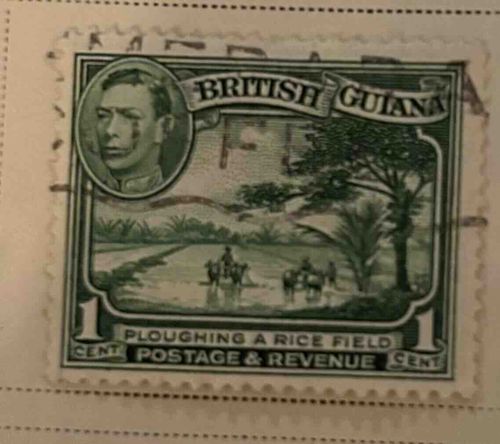
This is a philatelic item, specifically a postage and revenue stamp from British Guiana, featuring a portrait of King George VI and a scene depicting 'Ploughing a Rice Field'. The stamp is predominantly green and white, with the central design framed by a decorative border. The top left corner features a circular vignette of King George VI's profile, facing left. The detail on his face suggests a younger or middle-aged depiction, with noticeable lines or damage across his cheek and forehead, possibly indicating wear, a printing flaw, or an imperfection on the stamp itself. Above his portrait, the words 'BRITISH GUIANA' are prominently displayed in an arched banner. The main central image illustrates a rural scene of rice cultivation with workers and oxen ploughing a flooded field, flanked by tropical trees and foliage. The denomination '1 CENT' is present in both the bottom left and bottom right corners. Below the central image, text reads 'PLOUGHING A RICE FIELD' and 'POSTAGE & REVENUE'. The stamp exhibits a perforated edge, typical of postage stamps, suggesting it was separated from a sheet. The visible condition suggests some aging, with possible light toning on the paper and some potential creasing or minor tears along the perforations, though the image clarity is limited regarding these finer details. The style of the stamp, with the monarch's portrait and colonial imagery, is characteristic of British Commonwealth issues from the mid-20th century, likely dating to King George VI's reign (1936-1952). The craftsmanship appears to be of standard quality for issued stamps of that era, utilizing engraving or lithography to achieve the detailed imagery.
AI Appraisal Report
Upon examining the provided image of the British Guiana 1 Cent George VI 'Ploughing a Rice Field' stamp, I assess its condition to be fair to good, consistent with typical wear for a circulating postage stamp of this era. The visible 'lines or damage across his cheek and forehead' on King George VI's portrait are concerning. While these could be printing flaws, they also might indicate creasing or thinning, which would negatively impact value. The perforations appear largely intact, though minor wear or short perforations cannot be definitively ruled out without a closer look. Authenticity, based solely on this image, appears likely for a genuine issued stamp of the period. The design, printing style, and colonial iconography are consistent with British Commonwealth stamps from King George VI's reign (1936-1952).
Regarding market conditions, these specific 1 Cent 'Ploughing a Rice Field' stamps from British Guiana are generally common. They were produced in large quantities and are readily available to collectors. Therefore, demand is moderate for well-preserved examples but low for stamps with significant flaws. Rarity is not a factor here; this is not a key plate or a known error variety. The primary factors impacting value for this specific stamp are its condition (the mentioned lines/damage are a significant detractor), centering, and cancellation if present. If it's used, a light, neat cancellation would be preferable. If unused, the presence of original gum (OG) is crucial.
My valuation of $5 - $15 reflects a typical secondary market value for a common stamp in fair to good condition. For a definitive assessment of authenticity and condition, an in-person examination is essential to verify the gum condition, precisely identify any faults like thins, repairs, or re-perforations, and accurately grade the centering. High-resolution imaging under magnification would also help clarify the nature of the marks on the King's portrait. Furthermore, provenance documentation would confirm its history, though for a common stamp like this, it's rarely available or never required.