These notes were written by the person who submitted this item. Appraiser.AI has not verified them, and the AI's identification and estimate may rely on them.
AI Estimated Value
Not an official valuation
$15-30
AI estimate as of August 5, 2025 · verify with a professional before acting
AI-Generated · Verify before acting
Everything on this page is generated by AI for informational purposes only. AI can make mistakes — the AI may misidentify items or misattribute them (artist, maker, brand, designer, origin, era). This is not an official valuation and should not be used for insurance, sale, tax, estate, legal, or lending purposes — or any decision requiring a certified appraisal. It is not an authoritative claim about any person, brand, or rights holder — do not share or rely on it as a factual statement about a third party. Always consult qualified professionals before making financial decisions.
This analysis also relies on unverified notes provided by the user, which may be incomplete or inaccurate and could affect the result.
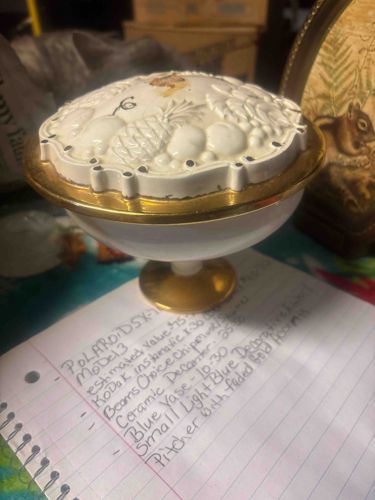
The item is a lidded ceramic dish, likely a serving dish or trinket box, resting on a pedestal base. The lid is predominantly white ceramic, featuring an embossed design of various fruits including pineapples, grapes, and other unidentified fruits, giving it a 'fruit basket' or 'cornucopia' aesthetic. The relief details are painted in an off-white to cream color, creating subtle contrast. There are small, dark, circular accents (possibly painted dots or raised beads) along the rim of the lid, mimicking decorative studs or stitching. The edge of the lid and the entire pedestal base are finished in a metallic gold color, suggesting gilding or a gold-tone electroplate, which provides a striking contrast to the white ceramic. The pedestal base elevates the dish, giving it a more formal and elegant appearance. Observable condition issues include significant wear or damage on the top center of the lid, where a large, irregular brownish-orange stain or missing glaze/material is present, indicating either impact damage, prolonged disuse, or a manufacturing flaw that has deteriorated. The gold finish on the base and rim appears to show some signs of aging or tarnishing, consistent with its likely age. The overall style suggests it could be from the mid-20th century, possibly the 1950s or 1960s, given the decorative and somewhat kitschy nature of the fruit motif combined with the gold accents. The item's construction appears to be ceramic, possibly porcelain or earthenware, given its opaque white appearance. The quality of craftsmanship seems to be moderate, focusing on decorative appeal rather than intricate hand-painted details. It's designed as a display piece or for serving, but the damage on the lid significantly impacts its aesthetic integrity and potential value.
AI Appraisal Report
Upon examining the provided image, I assess this lidded ceramic serving dish with a fruit motif on a pedestal. The condition significantly impacts its value. The prominent brownish-orange stain or missing material on the lid's top center is a notable flaw, suggesting either impact damage or a manufacturing defect that has deteriorated. This detractor severely compromises the item's aesthetic appeal and functionality as a display piece. Authenticity appears consistent with a mid-20th century ceramic piece, likely from the 1950s or 1960s, given the decorative style and gold accents. However, without handling the item, I cannot confirm specific material (porcelain vs. earthenware) or precise manufacturing techniques.
In terms of market conditions, items of this decorative style, often referred to as 'kitsch' or 'vintage home decor,' primarily appeal to collectors with very specific aesthetic tastes or those furnishing retro-themed interiors. Comparables in excellent condition typically command modest prices. The extensive damage on the lid limits its desirability, even within this niche market. Demand for such pieces is generally low to moderate. Rarity is not a factor here; similar mass-produced decorative ceramics from this era are relatively common. Factors significantly impacting value are almost entirely negative due to the damage.
For full authentication and to ascertain the exact nature of the lid's damage, a physical in-person examination would be crucial. This would allow for tactile inspection of the ceramic, closer examination of the gold finish for true gilding versus paint, and potentially chemical analysis of the stained area. Provenance documentation, though unlikely for an item of this type, could offer historical context.