AI estimate as of September 20, 2025 · verify with a professional before acting
AI-Generated · Verify before acting
Everything on this page is generated by AI for informational purposes only. AI can make mistakes — the AI may misidentify items or misattribute them (artist, maker, brand, designer, origin, era). This is not an official valuation and should not be used for insurance, sale, tax, estate, legal, or lending purposes — or any decision requiring a certified appraisal. It is not an authoritative claim about any person, brand, or rights holder — do not share or rely on it as a factual statement about a third party. Always consult qualified professionals before making financial decisions.
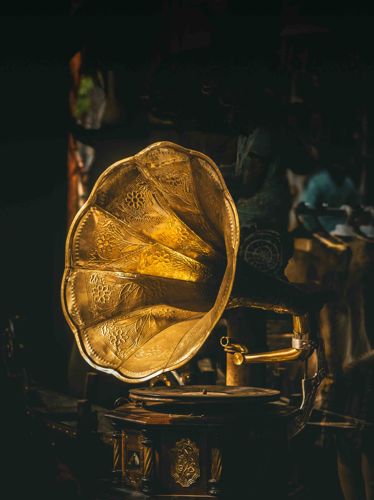
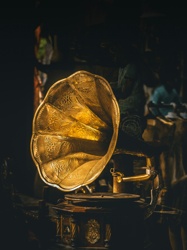
This item is an antique horn gramophone, characterized by its prominently displayed, large, ornate horn. The horn appears to be constructed from a polished metal, likely brass or a similar alloy, given its golden hue and reflective surface. It features a distinctive fluted, scalloped design around its outer edge, giving it a floral or fan-like appearance. The interior surfaces of the horn are adorned with intricate, embossed patterns, possibly floral motifs like stylized rosettes or leaves, repeated across each section. This decorative detailing suggests quality craftsmanship and an aesthetic focus beyond mere functionality. The gramophone's base, partially visible beneath the horn, appears to be made of dark wood, possibly mahogany or oak, with carved or applied decorative elements in a similar golden metallic finish as the horn. These embellishments on the cabinet seem to include volutes and other classical or ornate scrollwork, contributing to a rich, historical aesthetic. A circular turntable, likely felt-covered and dark in color, is visible on top of the cabinet, indicating its function as a record player. To the right, a brass crank handle and tone arm assembly are discernible, also exhibiting a polished metallic finish. The overall condition, based on the lighting and visible details, suggests some age-appropriate patina and possibly minor wear, but no significant damage or repairs are immediately evident. The rich golden color of the horn and metallic accents, combined with the dark cabinet, creates a striking contrast. This style of gramophone with an external horn was popular during the late 19th and early 20th centuries, placing its estimated age within that period, likely between 1890 and 1920. Quality indicators include the detailed embossing on the horn and the elaborate carving on the cabinet, suggesting it was a higher-end model for its time. The aesthetic hints at an Art Nouveau or Victorian influence.
AI Appraisal Report
Based on my visual examination of the provided image, this antique horn gramophone presents as a well-preserved example from the late 19th or early 20th century (circa 1890-1920), aligning with the described Art Nouveau or Victorian aesthetic. The authenticity appears strong based on the period-correct design elements, materials, and construction visible. The large, ornate brass horn with its distinctive fluted and scalloped edge, coupled with intricate embossed floral motifs, is a significant value driver, indicating a higher-end model. The dark wooden cabinet, seemingly mahogany or oak, with complementary gilded scrollwork, further reinforces its quality and decorative appeal. The visible brass crank handle, tone arm, and turntable appear original and consistent with the era. Condition appears excellent for its age, exhibiting an attractive patina with no immediately discernible significant damage or repairs. Market demand for such elaborate, well-preserved horn gramophones remains consistent among collectors, especially for pieces with distinctive decorative horns like this one. They are increasingly rarer to find in such complete and aesthetic condition. Factors significantly impacting value include the exceptional decorative quality of the horn and cabinet, and the apparent originality of all components. Comparables for pieces of this decorative caliber typically range higher than more utilitarian models. However, limitations arise from examining images alone; I cannot definitively assess the internal mechanism's functionality, the precise material composition of the metals and wood, or detect any subtle repairs or restorations that might impact value. An in-person examination would allow for a thorough inspection of the movement, verification of originality for all parts, and a more precise evaluation of finish integrity, which is crucial for full authentication and a definitive valuation.