These notes were written by the person who submitted this item. Appraiser.AI has not verified them, and the AI's identification and estimate may rely on them.
AI Estimated Value
Not an official valuation
$600-900
AI estimate as of September 28, 2025 · verify with a professional before acting
AI-Generated · Verify before acting
Everything on this page is generated by AI for informational purposes only. AI can make mistakes — the AI may misidentify items or misattribute them (artist, maker, brand, designer, origin, era). This is not an official valuation and should not be used for insurance, sale, tax, estate, legal, or lending purposes — or any decision requiring a certified appraisal. It is not an authoritative claim about any person, brand, or rights holder — do not share or rely on it as a factual statement about a third party. Always consult qualified professionals before making financial decisions.
This analysis also relies on unverified notes provided by the user, which may be incomplete or inaccurate and could affect the result.
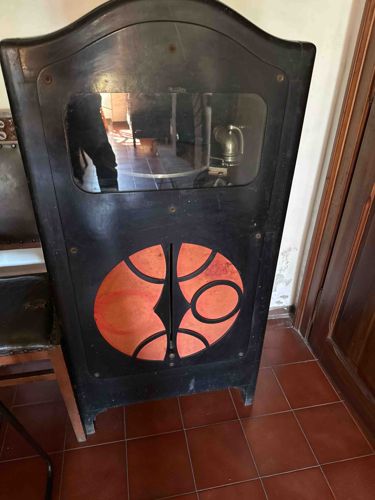
This is an antique cabinet gramophone, likely dating from the early to mid-20th century, possibly from the Art Deco period given its aesthetic. The gramophone is housed within a freestanding wooden cabinet, which appears to be constructed from a dark-stained or lacquered wood, giving it a rich, somewhat aged black finish. The top portion of the cabinet features a curved, somewhat decorative pediment or crest, and below this, a rectangular clear panel (likely glass or a similar transparent material) allows a view into the interior mechanism, specifically revealing a portion of the tone arm and reproducer – identifiable by its metallic, possibly brass or nickel-plated, elbow joint. The transparency of this upper window suggests it might have been designed to showcase the intricate workings or simply to indicate it's a sound-producing device. Below this viewing panel, the cabinet is adorned with a distinctive, geometric design in a contrasting reddish-orange or copper tone, featuring abstract, interlocking circular and elliptical shapes. This decorative panel is likely made of a different material, possibly a type of inlaid wood, veneer, or even a painted metal, accentuating the cabinet's visual appeal. The overall construction appears solid and substantial, indicating a well-made piece of furniture. Visible condition issues include some general signs of age and wear to the cabinet's finish, consistent with an item of its presumed vintage. There might be minor scratches, scuffs, or areas where the dark finish has thinned or tarnished, though no major damage like cracks or breaks are immediately apparent. The metallic components of the gramophone mechanism visible through the window show some patina, which is natural for aged metal. The cabinet stands on four small, integrated feet, characteristic of furniture from this era. The elegant, somewhat imposing stature and decorative elements suggest it was a focal point in a room, indicating both its functional purpose as a gramophone and its aesthetic value as a piece of furniture.
AI Appraisal Report
I've examined the provided image of this Antique Cabinet Gramophone. It appears to be a handsome piece, likely from the early to mid-20th century, possibly with Art Deco influences, as suggested by the geometric design. The dark-stained or lacquered finish, curved pediment, and abstract circular/elliptical decoration in a contrasting reddish-orange hue give it significant aesthetic appeal. The clear panel showcasing the tone arm and reproducer is a distinctive feature, adding to its visual interest as a conversation piece.
Condition-wise, based on the image, the cabinet shows general signs of age and wear consistent with its vintage – minor scuffs, scratches, and patina on the visible metallic components. No major structural damage like cracks or breaks are immediately apparent. The overall construction seems solid, indicating a well-made furnishing.
In terms of market conditions, demand for cabinet gramophones is moderate. While they are appreciated for their antique charm and decorative qualities, their functionality is often limited unless fully restored, which can be costly. Comparables in similar condition, especially those with appealing Art Deco characteristics, typically sell in the $500-$1000 range. The unique geometric inlay significantly enhances its decorative value, pushing it towards the higher end of that spectrum. Rarity is difficult to assess without knowing the manufacturer, but similar well-preserved examples surface periodically.
The primary factor impacting its value positively is its striking aesthetic and good visible condition. The functional state of the gramophone mechanism (motor, soundbox, etc.) is unknown from the image, and a non-working unit would fetch less than a fully functional one, unless purchased purely as furniture.
Authenticity verification relies heavily on visual cues alone here. To fully authenticate its age, manufacturer, and verify the originality of all components, an in-person examination would be crucial. This would allow me to inspect wood joints, internal mechanisms, manufacturer markings, and materials closely, and assess the extent of any repairs or restorations. Without physical inspection, I cannot verify the origin of its component parts or the integrity of its internal workings.