AI estimate as of December 1, 2025 · verify with a professional before acting
AI-Generated · Verify before acting
Everything on this page is generated by AI for informational purposes only. AI can make mistakes — the AI may misidentify items or misattribute them (artist, maker, brand, designer, origin, era). This is not an official valuation and should not be used for insurance, sale, tax, estate, legal, or lending purposes — or any decision requiring a certified appraisal. It is not an authoritative claim about any person, brand, or rights holder — do not share or rely on it as a factual statement about a third party. Always consult qualified professionals before making financial decisions.
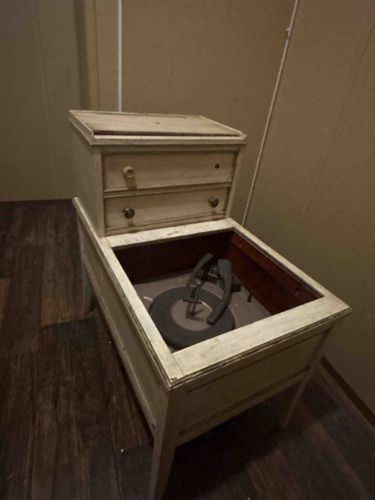
This item is a vintage phonograph housed within a wooden cabinet, likely from the early to mid-20th century. The cabinet appears to be constructed from wood, possibly pine or a similar light-colored timber, and features a distressed or whitewashed finish that gives it an aged aesthetic. The overall construction is rectangular, with four straight legs providing support, suggesting a utilitarian yet somewhat decorative design. The upper section of the cabinet features a smaller, box-like unit resting on top of the main body. This upper unit is designed with two false or shallow drawers, indicated by two round, light-colored wooden knobs on the top 'drawer,' though one knob is missing from the right side. The lower 'drawer' has two tarnished brass or bronze-toned pull handles, suggesting functional storage or merely aesthetic detailing. The main body of the cabinet has a large, open top compartment which houses the phonograph mechanism. Inside this compartment, the turntable and a substantial, black, u-shaped tonearm assembly with an integrated soundbox are visible. The internal wood of this compartment appears to be stained a darker, reddish-brown color, contrasting with the lighter exterior. The condition exhibits significant wear consistent with age and use. The whitewashed finish is uneven and shows areas where the natural wood grain might be peeking through, indicating either an intentional distressed look or natural wear over time. There are scuffs, scratches, and potential chips on the wooden surfaces, visible particularly on the edges and corners of the cabinet. The missing knob on the top 'drawer' is a clear condition issue. The metal components of the phonograph mechanism show some oxidation or dust accumulation, but no severe rust is immediately apparent. The overall craftsmanship suggests a functional piece of household furniture, possibly mass-produced, designed to integrate musical entertainment into a home setting. The simple forms and distressed finish might align with a rustic or early American style.
AI Appraisal Report
I've examined this vintage phonograph in a wooden cabinet, likely from the early to mid-20th century. Construed from what appears to be pine or a similar light-colored wood, the cabinet features a distressed or whitewashed finish, giving it an aged, rustic aesthetic. Its rectangular form and four straight legs suggest a utilitarian, mass-produced design. The top section, with its false drawers and single missing knob, along with the main body housing the phonograph mechanism, points to a piece designed to integrate entertainment into a home. Condition is consistent with age and use; the finish is uneven, showing scuffs, scratches, and potential chips, most notably on edges and corners, and the missing knob is a clear defect. The metal components show some oxidation but no severe rust.
Authenticity as a vintage piece appears certain from the visual cues of construction and wear. However, without in-person inspection, I cannot confirm if the distressed finish is original or a later modification, which could affect value. Similarly, the functional status of the phonograph mechanism itself—whether it plays—cannot be determined without physical testing.
Market conditions for vintage phonographs of this type are generally moderate. While there's a niche collector market, the appeal is often more decorative than functional for pieces in this condition. Comparables typically sell in the $100-$400 range, with higher values for fully restored, working models or those with unique historical significance. This piece's distressed aesthetic and condition issues, particularly the missing knob and unknown operational status, temper its value. Demand is present but not exceptionally high for unrestored, common models. Rarity is low as these were mass-produced. The primary factors impacting value here are its condition (distressed finish, missing knob), unknown operational status, and the lack of provenance. An in-person examination, including testing the phonograph's functionality, and documentation of its history would be crucial for a more precise valuation.