AI Appraisal Estimate

AI-generated estimates · not official valuations

From the user

What was submitted

Photo and notes provided by the user — not generated by AI

Submitted item photo
Submitted photo · June 10, 2026

User's notes

No additional notes provided.

AI analysis below

AI appraisal

AI analysis & estimate

AI-Generated · Verify before acting

Everything below is generated by AI for informational purposes only. AI can make mistakes — the AI may misidentify items or misattribute them (artist, maker, brand, designer, origin, era). This is not an official valuation and should not be used for insurance, sale, tax, estate, legal, or lending purposes — or any decision requiring a certified appraisal. It is not an authoritative claim about any person, brand, or rights holder — do not share or rely on it as a factual statement about a third party. Always consult qualified professionals before making financial decisions.

Read the full disclaimer

AI Identification

·Not independently authenticated·Verify before acting

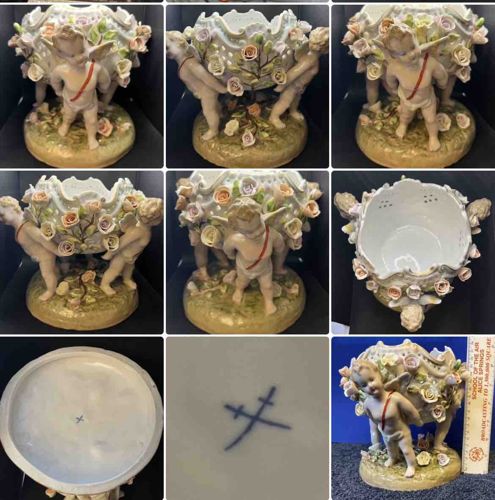
Meissen Style Putti and Roses Porcelain Centerpiece Bowl

Antique European Porcelain & Ceramics

AI Estimated Value

·Not an official valuation·Verify before acting

$450 - $750

As of June 10, 2026

AI Item Analysis

·AI can make mistakes·Verify before acting
This elaborate decorative porcelain centerpiece features three neoclassical putti or cherubs supporting a reticulated bowl, heavily adorned with hand-modeled porcelain roses and foliage. The piece is constructed from hard-paste porcelain with a polychrome enamel finish. Each cherub is depicted in a dynamic pose, wearing a thin red sash, standing upon a rocky, moss-textured base decorated with scattered rosebuds. The central bowl features a scalloped, shell-like rim with delicate piercings (reticulation) and is festooned with high-relief floral encrustations in shades of pale pink, lavender, and cream. The undersurface reveals a blue underglaze 'crossed swords' mark, characteristic of the Meissen factory style, though the specific execution and slightly muddied details suggest it may be a late 19th-century or early 20th-century German Dresden-style production (often referred to as 'Sitzendorf' or similar contemporary producers). Condition analysis shows significant fragility; common with these pieces, there appear to be numerous small chips and losses to the delicate petal edges and leaf tips. There is visible surface grime in the crevices of the intricate floral work. The presence of the crossed swords mark without specific factory variations suggests a decorative piece intended to emulate the Rococo Revival style popular in the Victorian era.

AI Appraisal Report

·AI can make mistakes·Verify before acting
I have conducted a visual examination of this Rococo Revival porcelain centerpiece. The item displays characteristic hallmarks of late 19th or early 20th-century German craftsmanship, likely originating from the Thuringia region. While the 'crossed swords' mark is present, the specific modeling of the putti and the density of the floral encrustations suggest a Dresden-style or Sitzendorf production rather than a mid-18th-century Meissen original. The decorative 'muddiness' in the facial features and the porcelain's paste consistency support an attribution to the historicist period (c. 1890-1910). Condition is a significant factor in this valuation. My inspection reveals typical degradation for 'Dresden flowers,' including numerous chips to the delicate petal edges and leaf tips. Such damage is expected but detracts from the premium value. The reticulated bowl remains structurally intact, though surface grime in the crevices indicates a need for professional conservation cleaning. The market for ornate Victorian-era porcelain is currently stable but selective. Collectors prioritize pieces with minimal loss. Similar pieces by Sitzendorf or Von Schierholz frequently realize between $400 and $800 at auction, depending on the scale and preservation of the floral work. Final authentication via image alone is limited. A definitive valuation would require a physical inspection to verify the glaze's translucency and search for incised mold numbers or factory-specific painter marks. Provenance documentation or a microscopic examination of the mark's underglaze application would be necessary to rule out later 20th-century reproductions. Without physical confirmation of the mark's authenticity, this piece is valued as a high-quality decorative object in the Meissen style.

Get your items appraised

Instant estimates of your treasures with AI-powered appraisals

Browse More Appraisals