These notes were written by the person who submitted this item. Appraiser.AI has not verified them, and the AI's identification and estimate may rely on them.
AI Estimated Value
Not an official valuation
$3 - $8
AI estimate as of August 31, 2025 · verify with a professional before acting
AI-Generated · Verify before acting
Everything on this page is generated by AI for informational purposes only. AI can make mistakes — the AI may misidentify items or misattribute them (artist, maker, brand, designer, origin, era). This is not an official valuation and should not be used for insurance, sale, tax, estate, legal, or lending purposes — or any decision requiring a certified appraisal. It is not an authoritative claim about any person, brand, or rights holder — do not share or rely on it as a factual statement about a third party. Always consult qualified professionals before making financial decisions.
This analysis also relies on unverified notes provided by the user, which may be incomplete or inaccurate and could affect the result.
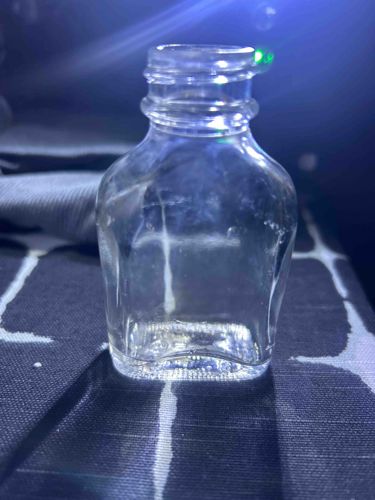
This item is a small, clear glass bottle, likely designed for holding liquids such as spirits, extracts, or samples. The bottle features a squat, somewhat rectangular body with subtly rounded shoulders that transition into a short, cylindrical neck. The neck is finished with machine-threaded rings, indicating it was designed to accept a screw-on cap. The glass appears to be of standard commercial quality, clear and free from significant discoloration, although some faint scratches or scuffs are visible from general handling and use. The base of the bottle is flat, providing stability, and exhibits a slight indentation or punt mark which is common in bottle manufacturing. There are no readily apparent maker's marks, labels, or embossed designs on its surface. The overall condition appears good, with no visible cracks, chips, or major damage, suggesting it is well-preserved. Its small size suggests it might be a miniature liquor bottle, a sample bottle, or a container for concentrated liquids. The manufacturing style, particularly the threaded neck, points to a modern to mid-20th-century or later production, utilizing automated glass bottle-making techniques. The craftsmanship is utilitarian but functional, typical of mass-produced glassware.
AI Appraisal Report
I have examined the provided image and description of the clear glass miniature bottle. Visually, the bottle appears to be in good condition, as described, with no visible cracks, chips, or major damage. The presence of subtle scuffs and a punt mark on the base are consistent with mass-produced utility glass. The threaded neck strongly indicates machine manufacturing, dating it to roughly the mid-20th century or later, as fully automated bottle production became widespread. The lack of maker's marks or distinctive design elements points to a common, utilitarian origin rather than a specialized or collectible piece.
Market conditions for such common, unembossed miniature glass bottles are generally low. Comparables on online marketplaces and at antique malls typically range from a few dollars to under ten dollars. These bottles are not rare, and the demand primarily comes from hobbyists, crafters, or individuals creating themed displays. Factors significantly impacting value would be unique embossing, a rare color, historical provenance (e.g., contents from a famous event), or a distinct manufacturer's mark, none of which are present here.
Based on this digital examination, the authenticity is consistent with a mass-produced item from the described era. However, without a physical inspection, I cannot definitively confirm the absence of subtle damage (e.g., hairline fractures), the precise quality of the glass, or any very faint marks that might be missed in an image. In-person examination would allow for tactile inspection and closer scrutiny of the glass surface. Provenance documentation, such as original packaging or content information, would add to its historical context but would likely not significantly alter its monetary value given the common nature of the item. Scientific testing is unnecessary for this type of object.