AI estimate as of September 12, 2025 · verify with a professional before acting
AI-Generated · Verify before acting
Everything on this page is generated by AI for informational purposes only. AI can make mistakes — the AI may misidentify items or misattribute them (artist, maker, brand, designer, origin, era). This is not an official valuation and should not be used for insurance, sale, tax, estate, legal, or lending purposes — or any decision requiring a certified appraisal. It is not an authoritative claim about any person, brand, or rights holder — do not share or rely on it as a factual statement about a third party. Always consult qualified professionals before making financial decisions.
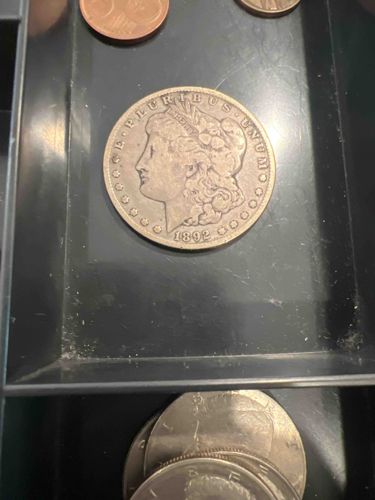
The item is an 1892 Morgan Silver Dollar, an iconic United States coin. It features the obverse (front) design, which showcases a left-facing profile of Lady Liberty. Her hair is intricately styled, adorned with a cap featuring wheat and cotton blossoms, and she wears a diadem inscribed with "LIBERTY." The motto "E PLURIBUS UNUM" is arched above her head, and the year "1892" is prominently displayed below her neck. The coin's rim is encircled by stars, though some are not fully visible due to the angle and potential wear. The material appears to be silver, consistent with Morgan Dollars, exhibiting a silvery-gray luster with areas of darker toning and patina, particularly in the recessed areas and on the fields. The coin shows signs of circulation consistent with its age, including surface scratches, some loss of detail on the high points of Liberty's hair and facial features, and general wear. There are no obvious deep gouges or significant damage, but the overall condition suggests it has been handled over time. The edge appears reeded, though this is not clearly visible. The craftsmanship is typical of U.S. Mint coinage of the late 19th century, known for its detailed engravings. The coin is housed within a black, partitioned coin tray, suggesting it is part of a collection and handled with some care. The presence of other coins nearby (a copper penny and what appears to be other silver coinage) suggests a numismatic context. The lack an identifiable mint mark, which would typically be below the eagle on the reverse, is not visible from this single obverse image. The toning appears natural, with no apparent signs of harsh cleaning that would significantly diminish its numismatic value beyond the wear from circulation.
AI Appraisal Report
I have carefully examined the provided image of this 1892 Morgan Silver Dollar. Based on my visual assessment, the coin appears authentic, consistent with known characteristics of United States Morgan Dollars. The design elements, including Lady Liberty's profile, the cap with wheat and cotton blossoms, and the inscription 'LIBERTY' on the diadem, all align with genuine examples. The 'E PLURIBUS UNUM' motto and the '1892' date are also correctly placed and styled.
From the image, I would grade this coin in the Fine (F) to Very Fine (VF) range. There is clear evidence of circulation wear, typical for a coin of this age. I observe loss of detail on the high points of Liberty's hair, her cheek, and some of the stars along the rim. Surface scratches are also present, which is common. The toning appears natural, a pleasing silvery-gray with darker patina in recessed areas, suggesting it has not been harshly cleaned, which would negatively impact its value. The reeded edge is not clearly visible, nor is a mint mark, which would typically be on the reverse and is crucial for precise valuation.
Market conditions for common date Morgan Dollars in this grade are stable. The 1892 is not considered a rare date, so its value is primarily driven by its silver content and numismatic appeal to collectors of circulated examples. Comparables in F-VF condition typically trade in the $40-60 range. Demand for these coins remains consistent among both new and experienced collectors.
Without a clear view of the reverse to identify a mint mark (e.g., 'S' for San Francisco, 'O' for New Orleans, or no mint mark for Philadelphia), the value is limited to a 'common date' assessment. Should it be a rarer mint like Carson City ('CC'), the value would be significantly higher. For full authentication and a definitive grade, a physical in-hand examination is essential. This would allow me to inspect both sides for all details, assess luster, feel the surface for any alterations, and verify the edge. Furthermore, verification of provenance documentation would provide additional assurance of its history and authenticity beyond visual inspection alone.