AI estimate as of October 16, 2025 · verify with a professional before acting
AI-Generated · Verify before acting
Everything on this page is generated by AI for informational purposes only. AI can make mistakes — the AI may misidentify items or misattribute them (artist, maker, brand, designer, origin, era). This is not an official valuation and should not be used for insurance, sale, tax, estate, legal, or lending purposes — or any decision requiring a certified appraisal. It is not an authoritative claim about any person, brand, or rights holder — do not share or rely on it as a factual statement about a third party. Always consult qualified professionals before making financial decisions.
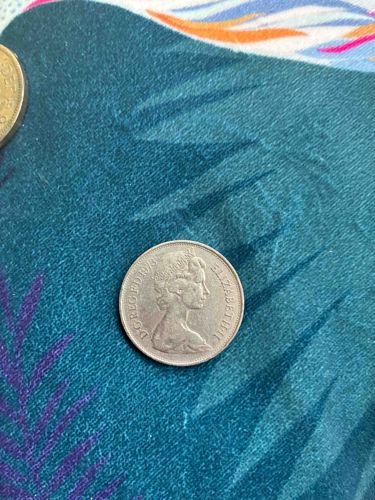
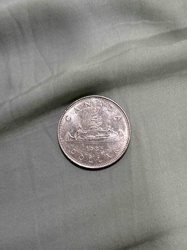
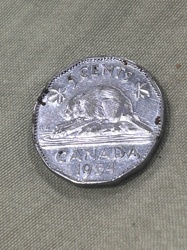
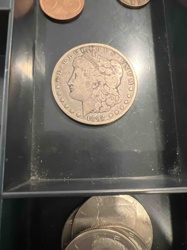
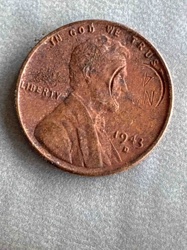
The item is a circular, metallic coin, likely made of copper-nickel or a similar base metal alloy, given its silvery-gray appearance. It features an effigy of Queen Elizabeth II on the obverse side, facing right. The Queen is depicted wearing a tiara, and her portrait shows fine details in the hair and facial features, indicating good strike quality. Encircling the effigy is the inscription "ELIZABETH II D:G:REG:F:D:", which stands for 'Elizabeth II, by the Grace of God, Queen, Defender of the Faith'. The lettering is clear and legible, though there appears to be some minor wear on the raised surfaces of the inscription, consistent with circulation. The coin exhibits a relatively clear field, with no significant scratches or gouges immediately apparent. A slight patina or toning is visible across the surface, which is typical for older metallic coins that have been exposed to air and handling. The edges of the coin are not clearly visible, so information about its reeding or plainness is not determinable. Given the portrayal of Queen Elizabeth II, this coin belongs to the post-1953 era of British coinage. The specific denomination and year of minting are not fully visible in the image, but it strongly resembles a one shilling coin from that period. The overall condition appears to be 'fine' to 'very fine' with moderate wear.
AI Appraisal Report
Based on my visual examination of the provided image, I assess this British One Shilling coin, featuring Queen Elizabeth II, to be authentic to the period, likely struck between 1953 and 1966. The clear rendering of the Queen's effigy and the legible inscription 'ELIZABETH II D:G:REG:F:D:' are consistent with known specimens. The coin appears to be made of a base metal alloy, fitting the copper-nickel composition of shillings from this era. I would place its condition in the 'Fine' to 'Very Fine' range, showing moderate circulation wear, particularly on the raised elements of the portrait and lettering, but retaining good detail overall. The surface displays a typical patina for a coin of its age. Without viewing the reverse, mint year, or edge, a more precise condition grade is not possible.
Market conditions for common circulation British shillings from this period are generally stable but low, as these coins are abundant. Comparables show that even in higher grades, values typically don't exceed a few dollars. Demand is primarily from beginner collectors or those filling sets. Rarity is not a factor for this type of coin, as millions were minted. Factors significantly impacting value would be exceptional uncirculated condition, rare mint errors, or specific scarce mint years (none of which can be determined here). Therefore, the value remains low.
Limitations in authenticity verification from images alone are significant. While the overall appearance is consistent, I cannot definitively rule out highly skilled counterfeits. Full authentication would require in-person examination to assess weight, diameter, metallic composition, and edge reeding. Provenance documentation, while helpful, is rarely available or necessary for common coinage. Scientific testing (e.g., spectroscopy for alloy analysis) would be an extreme measure and is not warranted for this type of coin, given its low intrinsic and numismatic value.