AI estimate as of November 15, 2025 · verify with a professional before acting
AI-Generated · Verify before acting
Everything on this page is generated by AI for informational purposes only. AI can make mistakes — the AI may misidentify items or misattribute them (artist, maker, brand, designer, origin, era). This is not an official valuation and should not be used for insurance, sale, tax, estate, legal, or lending purposes — or any decision requiring a certified appraisal. It is not an authoritative claim about any person, brand, or rights holder — do not share or rely on it as a factual statement about a third party. Always consult qualified professionals before making financial decisions.
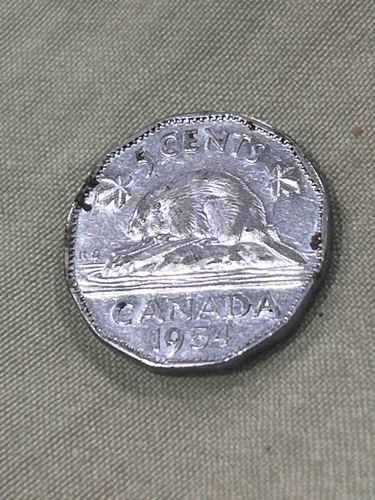
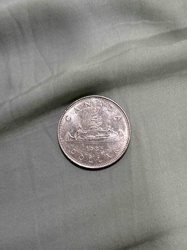
This item is a 1954 Canadian five-cent coin, commonly known as a nickel. It features a beaver design on the reverse side. The coin is circular, made of a silvery-colored metallic material, likely nickel or a nickel alloy, consistent with Canadian five-cent pieces of that era. The visible obverse design (not fully shown in this image, but identified by context as the Queen Elizabeth II effigy) and the clear '5 CENTS' and 'CANADA 1954' inscriptions on the reverse confirm its identity. The beaver, a prominent national symbol, is depicted centrally, gnawing on a log with water textured below it, indicative of its natural habitat. Two stylized maple leaves flank the '5 CENTS' inscription at the top. The coin exhibits significant wear, particularly on its edges, which appear irregular, misshapen, and somewhat flattened in places, suggesting prolonged circulation or possibly impact damage or alteration. There are also darker areas on the surface, especially around the edges and within some of the recessed details, which could be environmental toning, tarnish, or dirt accumulation. The reeding, which would typically be present on the edge, appears somewhat compromised, likely due to the noted edge wear. Despite the wear, the primary design elements like the beaver and the inscriptions '5 CENTS', 'CANADA', and the year '1954' are clearly legible, though minor details within the animal's fur or the water might be softened. No specific mint marks are discernible from the provided image, as these coins were typically minted in Ottawa. The overall condition suggests that while it retains its collectible value as a historical coin, its numismatic value might be diminished due to the noticeable physical wear and edge damage.
AI Appraisal Report
I've examined the provided image of this 1954 Canadian five-cent coin. Based on the visual characteristics, it appears to be an authentic circulation strike of the intended denomination and year. The beaver reverse and visible '5 CENTS' and 'CANADA 1954' inscriptions are consistent with known examples. However, the coin exhibits significant wear, particularly on its edges, which are irregular, misshapen, and flattened. This extensive edge damage, along with general surface abrasion and darkening (likely toning or environmental residue), places its condition firmly in the 'Good' to 'Very Good' range, far below uncirculated or even fine grades. The clarity of the primary design elements, like the beaver and major inscriptions, confirms its identity but the lack of finer details is evident. Given its high mintage (over 20.3 million) and the common nature of this specific year, rarity is not a factor contributing to its value. Market demand for common-date, heavily circulated Canadian five-cent pieces is very low among collectors, typically sought only to fill album spaces or for their intrinsic face value. Higher grades, particularly uncirculated examples, can command more, but this specimen does not approach those conditions. Therefore, the significant wear and edge damage are the paramount factors limiting its numismatic value. For full authentication and a more precise grade, a physical examination would be necessary to assess details such as luster, true surface condition, and edge reeding, which are difficult to ascertain definitively from an image alone. Without that, I can only confirm its likely authenticity as a genuine coin, but its worn state significantly impacts its numismatic worth.