AI Appraisal Estimate

AI-generated estimates · not official valuations

From the user

What was submitted

Photo and notes provided by the user — not generated by AI

Submitted item photo
Submitted photo · June 15, 2026

User's notes

We really don’t know much about this piece. It was part of the decor in an office that my husband purchased many years ago. The frame size is approximately 39” x 59”

AI analysis below

AI appraisal

AI analysis & estimate

AI-Generated · Verify before acting

Everything below is generated by AI for informational purposes only. AI can make mistakes — the AI may misidentify items or misattribute them (artist, maker, brand, designer, origin, era). This is not an official valuation and should not be used for insurance, sale, tax, estate, legal, or lending purposes — or any decision requiring a certified appraisal. It is not an authoritative claim about any person, brand, or rights holder — do not share or rely on it as a factual statement about a third party. Always consult qualified professionals before making financial decisions.

Note

This analysis also relies on unverified notes provided by the user, which may be incomplete or inaccurate and could affect the result.

Read the full disclaimer

AI Identification

·Not independently authenticated·Verify before acting

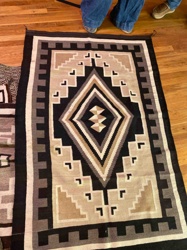
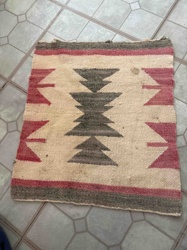
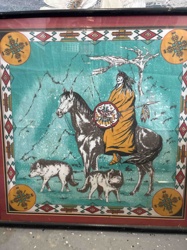
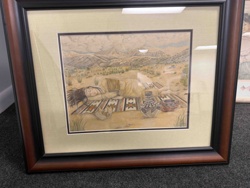
Framed Southwest or Zapotec Style Flat-Weave Textile

Art & Antiques / Textiles / Native American & Southwest Weavings

AI Estimated Value

·Not an official valuation·Verify before acting

$450 - $650

As of June 15, 2026

AI Item Analysis

·AI can make mistakes·Verify before acting
This is a large, hand-woven flat-weave textile, likely wool, presented in a custom shadowbox frame measuring approximately 39” x 59”. The weaving features a vertical orientation with a central white or cream field flanked by serrated 'dazzler' borders in a light tan or sand tone. The central field is decorated with alternating horizontal bands of geometric motifs, including stylized stepped diamonds and hourglass figures in a muted palette of sage green, dusty rose, and mustard yellow. The design and color scheme are characteristic of Southwestern aesthetics, specifically reminiscent of late 20th-century Zapotec weavings from Oaxaca or modern Navajo-inspired commercial rugs. The top and bottom of the textile exhibit light-colored fringe, which appears relatively intact. The piece is mounted against a dark forest-green matte that provides a strong contrast to the pale tones of the wool. The frame appears to be a simple thin-profile wood or metal in a rose-gold or copper tone. Based on the pastel 'Santa Fe style' color palette, this item likely dates to the 1980s or 1990s. The textile appears to be in good overall condition with no significant staining or moth damage visible behind the glass, though some light sagging is present due to its vertical mount.
AI Appraisal Report

·AI can make mistakes·Verify before acting
Based on my visual examination of the framed flat-weave textile, I identify this piece as a contemporary Zapotec weaving from Oaxaca, Mexico, dating to the 1980s or 1990s. The 'Santa Fe' pastel palette—sage, rose, and mustard—was highly popular during this era for Southwest-themed interior design. The serrated 'dazzler' borders and stepped geometric motifs are classic Zapotec interpretations of traditional Navajo patterns. The textile is presented in a custom shadowbox frame, which indicates it was valued as decorative art rather than a floor covering. The condition appears very good, with the wool maintaining its structure, though slight sagging suggests it may need re-mounting to prevent tension damage over time. The primary value drivers are the large scale and the cost of the professional framing, which likely exceeds the value of the textile itself. In the current market, mid-to-late 20th-century Zapotec rugs are common; they lack the rarity and collectible value of authentic antique Navajo weavings, which can command thousands. Comparable sales for framed Zapotec pieces of this size typically fall between $400 and $700 at auction or specialized estate sales. Limitations: This assessment is based on visual evidence alone. A physical inspection is required to confirm fiber content (wool vs. synthetic) and to check for hidden moth damage or dye bleeding behind the glass. To fully authenticate this as a high-quality Zapotec or potentially a commercial Navajo-style weave, I would need to examine the selvage (edges) and weave count (weft-faced density). Provenance regarding the original gallery of purchase would further clarify its origin.

Get your items appraised

Instant estimates of your treasures with AI-powered appraisals

Browse More Appraisals