AI Appraisal Estimate

AI-generated estimates · not official valuations

From the user

What was submitted

Photo and notes provided by the user — not generated by AI

Submitted item photo
Submitted photo · May 27, 2026

User's notes

No additional notes provided.

AI analysis below

AI appraisal

AI analysis & estimate

AI-Generated · Verify before acting

Everything below is generated by AI for informational purposes only. AI can make mistakes — the AI may misidentify items or misattribute them (artist, maker, brand, designer, origin, era). This is not an official valuation and should not be used for insurance, sale, tax, estate, legal, or lending purposes — or any decision requiring a certified appraisal. It is not an authoritative claim about any person, brand, or rights holder — do not share or rely on it as a factual statement about a third party. Always consult qualified professionals before making financial decisions.

Read the full disclaimer

AI Identification

·Not independently authenticated·Verify before acting

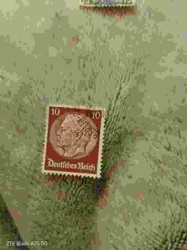
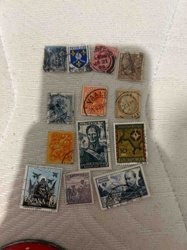
Germany 1932 Paul von Hindenburg 6 Pfennig Postage Stamp

Philately / Postage Stamps

AI Estimated Value

·Not an official valuation·Verify before acting

$0.25 - $1.00

As of May 27, 2026

AI Item Analysis

·AI can make mistakes·Verify before acting
This is a 6 Pfennig postage stamp from Germany's Weimar Republic or early Third Reich period, specifically from the Hindenburg Medallion series issued around 1932-1933. The stamp features a profile portrait of Paul von Hindenburg, the second President of Germany, set within a circular medallion. The design is printed in a distinct deep green ink on white or off-white paper. At the bottom, 'Deutsches Reich' is printed in a traditional Fraktur (Gothic) typeface. The denomination '6' is prominently displayed in the upper right and left corners. Physically, the stamp features standard serrated perforations along all four edges. A notable feature is the presence of a black circular date stamp (CDS) or wave cancellation mark running horizontally across the center of the image, indicating the stamp was postally used. The condition shows slight rounding of the perforation tips and some minor discoloration consistent with age and postal handling. This specific portrait design was widely used for several years, representing a transition period in German philately. The printing quality is characteristic of state-produced intaglio or typography of that era, showing fine engraving lines in the hair and facial features of Hindenburg.

AI Appraisal Report

·AI can make mistakes·Verify before acting
I have completed a visual examination of the Germany 6 Pfennig Hindenburg Medallion stamp, issued in 1932/33 as part of the Michel catalog number 469 series. The specimen features a profile of President Paul von Hindenburg in deep green. Based on the digital image, the stamp appears authentic, exhibiting the correct typography and serrated perforations typical of State Printing Office production. This specific example is postally used, featuring a wave or circular date stamp (CDS) cancellation. The condition of the stamp is graded as 'Fine-Used.' I note some minor softening of the perforation tips and typical toning associated with age. In the philatelic market, this particular issue is categorized as 'extremely common.' During the early 1930s, this was a standard domestic postcard rate stamp, produced in the hundreds of millions. Consequently, high supply significantly limits the secondary market value for single specimens. Comparables for this item regularly sell in bulk 'kiloware' or as part of entry-level collections. While it is a piece of historical interest representing the Weimar-Third Reich transition, it lacks the rarity or 'premium' cancellation (such as a first-day or rare localized postmark) required to command a higher price. Limitations: My assessment is based purely on digital resolution. A physical examination is necessary to verify the integrity of the paper, detect hidden thins, or identify specific watermarks (typically the Waffle pattern) that could denote a rare sub-variety. Scientific testing for gum residue or fluorescent characteristics would be required for a definitive certificate of authenticity, though the low market value generally precludes the cost of such formal certification.

Get your items appraised

Instant estimates of your treasures with AI-powered appraisals

Browse More Appraisals