AI estimate as of August 24, 2025 · verify with a professional before acting
AI-Generated · Verify before acting
Everything on this page is generated by AI for informational purposes only. AI can make mistakes — the AI may misidentify items or misattribute them (artist, maker, brand, designer, origin, era). This is not an official valuation and should not be used for insurance, sale, tax, estate, legal, or lending purposes — or any decision requiring a certified appraisal. It is not an authoritative claim about any person, brand, or rights holder — do not share or rely on it as a factual statement about a third party. Always consult qualified professionals before making financial decisions.
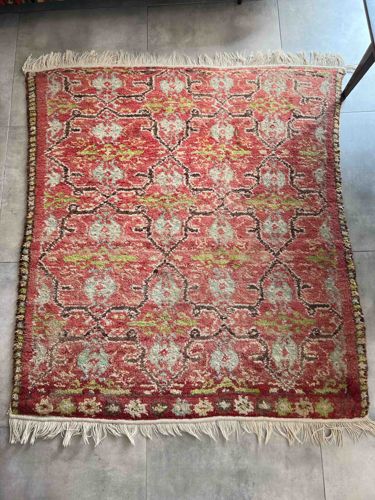
This item is a rectangle-shaped area rug, likely hand-knotted or hand-woven, featuring an aged and faded appearance. The dominant color is a rich, faded red or crimson, serving as the background for an intricate all-over design. The pattern appears to be a repeating geometric or stylized floral motif, possibly a lattice or quatrefoil design, rendered in lighter tones of muted green, light blue/grey, and black/dark brown. The colors exhibit a mottled, distressed quality, characteristic of 'abrash' (slight variations in color due to different dye lots) or intentional fading for an antique look. The rug has visible fringed ends, which are off-white or cream in color, showing some natural wear and unevenness. The edges of the rug, particularly along the sides, appear to be securely bound, showing a darker brown or black stitching which provides a neat finish. The pile seems to be medium to low, and the overall construction suggests wool or a wool blend. Given the traditional design and distressed finish, it appears to be either an antique or vintage piece, or a modern reproduction designed to emulate an older aesthetic. There are no clear visible manufacturing marks or signatures from the image. The condition shows a natural patina and color variations that contribute to its character, with no obvious major damage such as rips or holes, though general wear consistent with age and use is present across the pile.
AI Appraisal Report
Upon examining the provided image of this Red Area Rug with Geometric Pattern, I assess its condition as good, retaining a desirable 'distressed' aesthetic. The faded red, muted greens, and blues, coupled with the geometric motif, suggest a traditional design, likely Persian or Turkoman inspiration. The visible abrash and general wear patterns on the pile and fringes are consistent with either genuine age or a high-quality reproduction aiming for an antique look. Based on visual cues alone, it's challenging to definitively determine if this is a true antique/vintage hand-knotted piece or a modern machine-made rug designed to mimic age. The quality of the binding and fringing appears consistent with hand-finishing, but this cannot be confirmed without a physical inspection of the knot density and construction. Market conditions for distressed and vintage-style rugs are currently strong, with high demand for pieces that offer character and warmth. While authentic antique rugs command premium prices for their rarity and craftsmanship, reproductions that convincingly emulate this aesthetic also fetch good value. Factors impacting value include material (wool vs. synthetic), knot count, origin, and genuine age vs. manufactured distress. Without in-person examination, I cannot attest to the fiber content, actual age, or specific region of origin. To fully authenticate, I would require a physical inspection to assess knot structure, fiber type, dye analysis, and wear patterns not evident from images. Provenance documentation would also be crucial. For full authentication, fiber testing, dye analysis, and a detailed examination of knotting techniques would be necessary.