AI estimate as of October 4, 2025 · verify with a professional before acting
AI-Generated · Verify before acting
Everything on this page is generated by AI for informational purposes only. AI can make mistakes — the AI may misidentify items or misattribute them (artist, maker, brand, designer, origin, era). This is not an official valuation and should not be used for insurance, sale, tax, estate, legal, or lending purposes — or any decision requiring a certified appraisal. It is not an authoritative claim about any person, brand, or rights holder — do not share or rely on it as a factual statement about a third party. Always consult qualified professionals before making financial decisions.
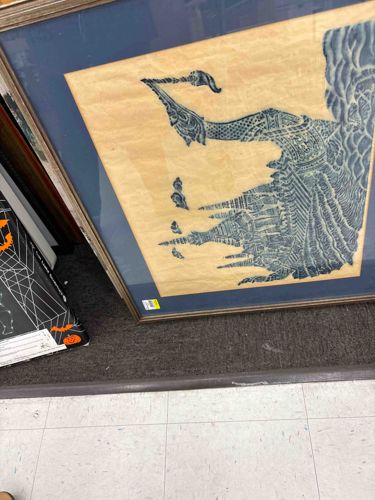
This item is a framed piece of textile art, possibly a batik or a block print on fabric, depicting a fantastical or mythological creature, potentially a stylized bird or a Nāga, rendered in intricate detail. The artwork features a dark blue or indigo design on a light, unbleached, or tea-stained natural fiber textile, likely cotton or linen, which has a visible grain and some textural inconsistencies, indicating its natural origin. The design itself encompasses a large portion of the textile, showcasing complex patterns resembling scales, feathers, or architectural motifs, creating a sense of depth and form within the creature's body. Small, teardrop-like forms are depicted falling or floating below the main creature, possibly representing water, scales, or symbolic elements. The textile art is housed behind glass within a wooden frame, which appears to be a medium-toned wood with a simple, slightly ornate profile, possibly with a thin gold or bronze inner trim. A dark blue matboard surrounds the textile, providing a strong contrast and enhancing the blue tones within the artwork. The visible condition suggests some age; the textile shows slight discoloration or uneven toning, possibly intentional aging or natural patina. The frame appears to be in good condition with minor scuffs consistent with general handling, given its appearance in what looks like a retail or thrift store setting. There are no discernible maker's marks or signatures visible in the provided image. The style appears to be influenced by Southeast Asian or East Asian traditional art, specifically in the rendering of the creature and the detailed patterns. The craftsmanship is evident in the fine lines and detailed execution of the textile print, suggesting a skilled artisan.
AI Appraisal Report
Upon examining the images of this framed textile art, I assess it to be a skillfully executed decorative piece, likely a modern production influenced by traditional Southeast Asian art styles. The technique appears to be batik or a well-made block print on a natural fiber fabric, possibly cotton or linen. The creature depicted, likely a stylized bird or Nāga, is rendered with intricate detail, suggesting a proficient artisan. The piece is in good condition, with the textile showing some minor, possibly intentional, discoloration that adds to its aesthetic appeal. The framing, with its dark blue matboard and simple wooden frame, is complementary and well-maintained.
The valuation of this piece is significantly impacted by the lack of a visible artist's signature or maker's mark, and the absence of any provenance. Without these, it is difficult to attribute the work to a specific artist, workshop, or region, which limits its collectability and places it within the decorative art market. The market for such unsigned, decorative textile art is generally modest. Comparable unsigned, good-quality batik or block prints of this size and complexity typically sell in the lower range.
It is crucial to note the limitations of an appraisal based solely on images. I cannot definitively authenticate the technique (e.g., hand-drawn batik vs. screen-print) or determine the exact age of the textile without physical inspection. A full authentication would require de-framing the piece to examine the textile's reverse side and edges, performing a fiber analysis, and searching for any hidden marks. Documentation regarding its origin or artist would be necessary to elevate its value beyond the decorative category.