These notes were written by the person who submitted this item. Appraiser.AI has not verified them, and the AI's identification and estimate may rely on them.
AI Estimated Value
Not an official valuation
$150-$250
AI estimate as of October 31, 2025 · verify with a professional before acting
AI-Generated · Verify before acting
Everything on this page is generated by AI for informational purposes only. AI can make mistakes — the AI may misidentify items or misattribute them (artist, maker, brand, designer, origin, era). This is not an official valuation and should not be used for insurance, sale, tax, estate, legal, or lending purposes — or any decision requiring a certified appraisal. It is not an authoritative claim about any person, brand, or rights holder — do not share or rely on it as a factual statement about a third party. Always consult qualified professionals before making financial decisions.
This analysis also relies on unverified notes provided by the user, which may be incomplete or inaccurate and could affect the result.
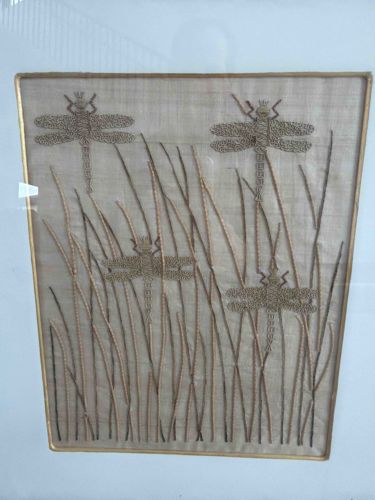
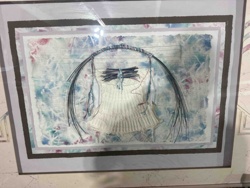
This item is an embroidered textile art piece featuring a naturalistic scene of dragonflies amidst reeds, presented within a thin, metallic-toned frame. The primary material appears to be a light-colored, possibly linen or silk, fabric serving as the canvas, exhibiting some natural variations in weave and slight creasing or wrinkles inherent to textile. The embroidery itself is executed with a combination of metallic or subtly iridescent threads, primarily in shades of muted gold, bronze, and brown. Four dragonflies are depicted, two larger ones positioned towards the top and two smaller ones towards the bottom, each crafted with intricate detail. Their bodies and wings are densely embroidered, possibly using seed beads or very fine, tightly packed stitching to create a textured, shimmering effect, mimicking the iridescence of real dragonflies. The reeds are depicted as long, slender stalks extending upwards from the bottom of the piece, created with linear embroidery stitches that vary in thickness and color, providing a sense of depth and movement. Some reeds appear to be made of thicker, twisted thread or even thin cords, adding to the three-dimensional quality. The overall color palette is subdued and earthy, focusing on natural tones that suggest a tranquil scene. The textile is enclosed by a simple, thin frame that appears to be made of metal or wood with a metallic gold finish, providing a clean border to the artwork. The frame shows some minor wear or patina consistent with its age, possibly around 2004 as suggested by the context. No specific maker's marks or signatures are visible in the provided image. The craftsmanship appears to be of good quality, with attention to detail in the embroidery work, suggesting it could be a handcrafted or artisan piece. The piece conveys a serene aesthetic, suitable for decorative purposes.
AI Appraisal Report
I have examined the provided image of the Embroidered Dragonfly and Reed Textile Art. The condition appears good, with the textile exhibiting minor natural variations and slight creasing, which is typical for such a material. The embroidery work is intricate and well-executed, showing no obvious signs of damage or significant wear. The frame displays some minor wear or patina, consistent with an item dated around 2004. Authenticity, based solely on visual inspection, suggests a handcrafted or artisan piece, given the detailed embroidery and lack of mass-produced characteristics.
Market conditions for contemporary textile art of this type generally place it within the decorative arts category. Comparables often include framed needlework or embroidered pieces from independent artists or small craft studios. There is a steady, albeit niche, demand for unique, well-executed textile art, particularly pieces with naturalistic themes. Given its apparent age and the quality of craftsmanship, it is not particularly rare, but its handmade nature contributes to its appeal.
Factors impacting value include the good condition, the detailed and varied embroidery techniques (including potential use of metallic threads and seed beads for iridescence), and its attractive, serene aesthetic. The simple, well-suited frame also adds to its presentation. However, the absence of a visible artist's signature or provenance limits its potential value as a collectible art piece from a known maker.
It is crucial to note that my assessment of authenticity and material specifics is based solely on visual examination of the image. A full authentication would require an in-person examination to assess the fiber content, embroidery techniques up close, and the actual condition of the textile and frame. Provenance documentation, such as artist's statements, purchase receipts, or exhibition history, would be essential to definitively attribute the work to a specific artist and to verify its origin beyond the stated year of 2004.