These notes were written by the person who submitted this item. Appraiser.AI has not verified them, and the AI's identification and estimate may rely on them.
AI Estimated Value
Not an official valuation
$400-800
AI estimate as of July 27, 2025 · verify with a professional before acting
AI-Generated · Verify before acting
Everything on this page is generated by AI for informational purposes only. AI can make mistakes — the AI may misidentify items or misattribute them (artist, maker, brand, designer, origin, era). This is not an official valuation and should not be used for insurance, sale, tax, estate, legal, or lending purposes — or any decision requiring a certified appraisal. It is not an authoritative claim about any person, brand, or rights holder — do not share or rely on it as a factual statement about a third party. Always consult qualified professionals before making financial decisions.
This analysis also relies on unverified notes provided by the user, which may be incomplete or inaccurate and could affect the result.
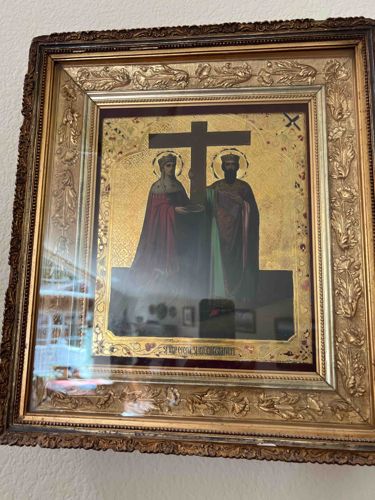
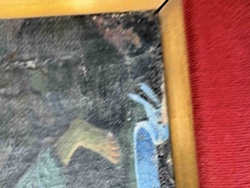
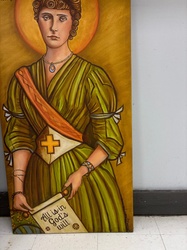
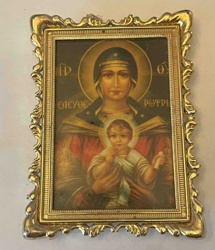
This item is an antique or vintage religious icon, likely of Eastern Orthodox Christian tradition, depicting a male and female saint, possibly Sts. Constantine and Helena, standing on either side of a large black cross. The iconography suggests the Finding of the True Cross. The figures are rendered in a traditional iconographic style with haloed heads, and their robes display rich colors, with the female figure in red/purple and the male in green/blue. The background of the icon is predominantly gold, likely painted or applied with gold leaf, featuring intricate patterned details, typical of icons. A Greek or Cyrillic inscription is visible at the bottom of the central image, contributing to the item's authenticity and potential origin. The icon is housed behind glass within a multi-layered, ornate frame. The innermost layer of the frame appears to be gold-painted wood or gesso, with a patterned border, possibly a repeating floral or geometric motif. This is surrounded by a wider frame section adorned with detailed, raised relief carvings of scrolling foliage, such as acanthus leaves, also finished in gold paint. The outermost frame layer is darker, possibly stained or ebonized wood, with a decorative carved edge further enhancing its elaborate appearance. Visible condition issues include some scuffing and minor losses to the gold paint on the frame, consistent with age and handling. There appears to be some dust or debris under the glass, and reflections on the glass obscure some minor details of the icon itself. The craftsmanship of the frame suggests a late 19th or early 20th-century period, providing a robust and fitting enclosure for the religious artwork within. The overall quality indicates a well-crafted piece, designed to be both devotional and decorative.
AI Appraisal Report
Upon examining the provided image and description of the Icon of Saints Constantine and Helena with the True Cross, I can offer the following appraisal. The icon itself, depicting Sts. Constantine and Helena with the True Cross, appears to be of the Eastern Orthodox tradition, displaying classic iconography with haloed figures, rich robes, and a gold-leafed or painted background with intricate patterns. The visible Greek or Cyrillic inscription adds significantly to its potential authenticity and origin. The ornate gilt frame, with its multi-layered design featuring highly detailed relief carvings of scrolling foliage and a darker outer layer, is consistent with late 19th or early 20th-century craftsmanship. These frames are desirable in their own right.
Regarding condition, I observe scuffing and minor losses to the gold paint on the frame, typical for an item of this age. The presence of dust or debris under the glass and reflections impacting visibility are noted, making a full assessment of the icon's surface condition difficult without physical examination. These are minor condition issues that would not significantly detract from value for most collectors.
In terms of market conditions, religious iconography, particularly well-preserved pieces with attractive, period-appropriate frames, continues to hold a stable demand. While not exceedingly rare, icons from this period with good detail and a discernible inscription are sought after by collectors of religious art, Eastern Orthodox adherents, and those appreciating decorative antique objects. The craftsmanship of the frame elevates the item beyond a simple devotional piece, increasing its decorative appeal. Factors impacting value include the quality of the painting, the specific saints depicted (Constantine and Helena are popular), the age, and the overall aesthetic appeal of the piece in its frame. For a full authenticity verification of the icon's age and origin, an in-person examination to assess paint layers, wood type, and potential underdrawings would be crucial. Professional cleaning and assessment of the icon's surface, and potentially dendrochronology for the wood panel, would be beneficial. Without physical inspection, I cannot confirm if the gold elements on the icon are true gold leaf or paint, which could influence value. Provenance documentation, if available, would further enhance authentication and value.
Based on what can be ascertained from the image and description, and considering current market trends for similar pieces, I assess the value as follows.