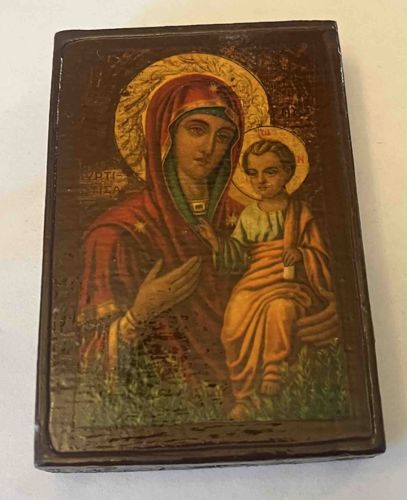
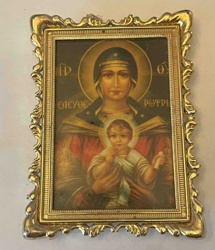
Wooden Greek Orthodox icon, approximately 9.5 cm x 6.5 cm
These notes were written by the person who submitted this item. Appraiser.AI has not verified them, and the AI's identification and estimate may rely on them.
AI Estimated Value
Not an official valuation
$40-75
AI estimate as of July 19, 2025 · verify with a professional before acting
AI-Generated · Verify before acting
Everything on this page is generated by AI for informational purposes only. AI can make mistakes — the AI may misidentify items or misattribute them (artist, maker, brand, designer, origin, era). This is not an official valuation and should not be used for insurance, sale, tax, estate, legal, or lending purposes — or any decision requiring a certified appraisal. It is not an authoritative claim about any person, brand, or rights holder — do not share or rely on it as a factual statement about a third party. Always consult qualified professionals before making financial decisions.
This analysis also relies on unverified notes provided by the user, which may be incomplete or inaccurate and could affect the result.
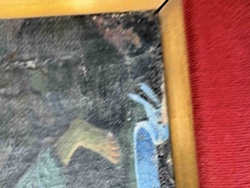
This item is a small, rectangular wooden Greek Orthodox icon depicting the Theotokos (Virgin Mary) and Christ Child. The icon measures approximately 9.5 cm in height and 6.5 cm in width, indicating its size as a personal or travel icon. The image appears to be a chromolithograph or a printed image, affixed to a wooden panel and possibly varnished or lacquered, rather than a hand-painted piece. The colors are rich and retain good saturation, featuring the traditional red and blue garments for the Virgin Mary, and orange-gold tones for the Christ Child's robes, all accented with golden halos. Greek inscriptions are visible on the left side, confirming its Orthodox origin. The craftsmanship suggests a commercially produced item, possibly from the late 19th or early 20th century, common as devotional objects. Visible condition issues include some surface wear, particularly in the lower half where the image appears slightly faded or abraded, and minor loss of the protective coating. There is also some visible scratching or crazing on the surface. The wood itself shows signs of age, with darkened edges and a generally subdued patina. The edges of the wooden panel are dark brown and show slight wear, consistent with handling over time. The overall impression is that of a well-used, cherished religious artifact.
AI Appraisal Report
I have examined the provided image and information for this small wooden Greek Orthodox icon depicting the Theotokos and Christ Child. Based on visual assessment, the item appears to be a commercially produced chromolithograph or printed image affixed to a wooden panel, rather than a hand-painted piece. This significantly impacts its value compared to hand-painted icons.
The condition, as observed from the image, shows surface wear, fading/abrasion in the lower half, minor loss of protective coating, and visible scratching or crazing. The wooden panel exhibits signs of age, consistent with a late 19th or early 20th-century devotional object.
In terms of market conditions, printed devotional icons of this type are relatively common. While they hold sentimental and religious value, their artistic and monetary value is generally modest. Comparables in the market for similar printed religious artifacts typically fall into the low hundreds of dollars, if that. Demand exists among collectors of religious art and Orthodox adherents, but rarity is low due to the mass-produced nature.
Factors significantly impacting value include the printed nature versus hand-painting, and the visible condition issues. The small size also contributes to its designation as a personal or travel icon, which can sometimes be more desirable but in this case does not offset the other factors.
It is crucial to note the limitations of authenticity verification from images alone. While I assess this to be a printed icon, an in-person examination would be necessary to definitively confirm the printing technique (e.g., chromolithography, offset print) and to assess the true extent of surface wear, potential repairs, and wood characteristics. Provenance documentation, such as the item's history of ownership or acquisition records, would provide invaluable context but is not available. Scientific testing, like pigment analysis (though less relevant for a printed piece) or wood dating, would be overkill for an item of this type but could offer definitive age confirmation if ever required for a more valuable, hand-painted icon.