AI estimate as of November 1, 2025 · verify with a professional before acting
AI-Generated · Verify before acting
Everything on this page is generated by AI for informational purposes only. AI can make mistakes — the AI may misidentify items or misattribute them (artist, maker, brand, designer, origin, era). This is not an official valuation and should not be used for insurance, sale, tax, estate, legal, or lending purposes — or any decision requiring a certified appraisal. It is not an authoritative claim about any person, brand, or rights holder — do not share or rely on it as a factual statement about a third party. Always consult qualified professionals before making financial decisions.
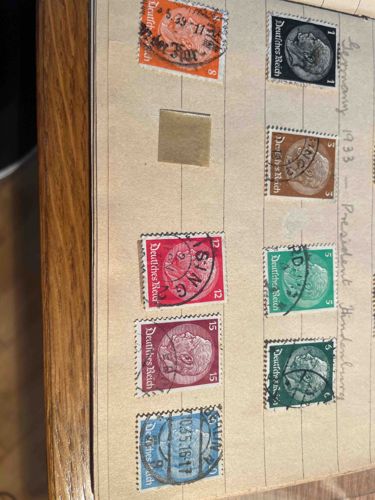
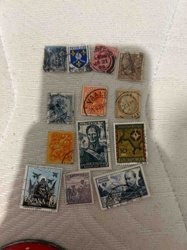
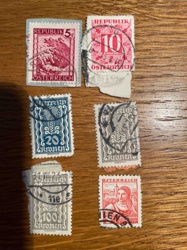
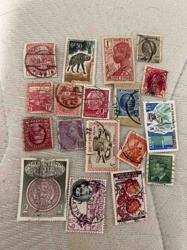
This item is a page from a stamp album displaying a collection of German postage stamps, primarily from the 'President Hindenburg' definitive series issued in 1933. The page itself is a light beige or off-white paper, likely acid-free for philatelic preservation, with faint horizontal and vertical grid lines visible, aiding in stamp placement and organization. A wooden frame or boundary is visible on the left side, suggesting the album's binding. Most stamps are square or rectangular, perforated along their edges, indicating their origin as collectible postage stamps. They feature a portrait of Paul von Hindenburg, the second President of Germany, prominently in the center. The stamps display a variety of denominations and colors: a black 1 Pfennig, a brown 3 Pfennig, green 5 Pfennig (two examples, one lighter, one darker), red 12 Pfennig, purple (or reddish-brown) 15 Pfennig, and a blue 20 Pfennig. Another orange stamp, seemingly of a different series, is present at the top left, with a prominent circular postmark and a denomination of '8' Pfennig. Most stamps bear postmarks, indicating they were used for postage, with various dates and locations visible, such as 'BERLIN' on the blue 20 Pfennig stamp (dated '10.35.16-17'). The postmarks are generally black ink, circular or semi-circular, covering part of the Hindenburg portrait. All stamps bear the inscription 'Deutsches Reich' (German Realm). A small, blank, light brown square, possibly a placeholder for a missing stamp or a hinge, is present in the upper-middle section of the page. The overall condition appears fair to good for used stamps of this age, with visible cancellations, slight variations in color and centering, and the natural patina associated with philatelic items. The arrangement on the page is somewhat organized, with denominations grouped together, and handwritten annotations to the right note 'Germany 1933 - President Hindenburg'. These stamps are standard examples of German definitive issues from the early 1930s, reflecting the political climate of the Weimar Republic's final years.
AI Appraisal Report
I have visually examined this collection of German 'President Hindenburg' definitive postage stamps from 1933. The presentation on a classic album page with grid lines and handwritten annotations suggests a collector's item. The stamps themselves, depicting Paul von Hindenburg, appear authentic based on their design, 'Deutsches Reich' inscription, and perforation characteristics, consistent with this widely issued series. Most stamps are postmarked, indicating used condition, which generally fetches lower values than unused stamps. The a black 1 Pfennig, a brown 3 Pfennig, two green 5 Pfennig, a red 12 Pfennig, a purple 15 Pfennig, and a blue 20 Pfennig are standard issues. The orange '8' Pfennig stamp at the top left appears to be from a different series, possibly the large 'Reichsadler' issue, and its exact series isn't fully discernible. The condition is fair to good for used stamps of this era; postmarks are often heavy and cover significant portions of the design, which is typical but can diminish aesthetic appeal for some collectors. These Hindenburg definitives are common. Market conditions for these specific used stamps are generally low, as millions were printed and used. There is consistent but not high demand, and they are not considered rare. Factors impacting value are primarily the commonality of the issues and their used condition. Higher denominations, specific plate varieties, or exceptional postmarks could increase value, but none are clearly evident here. Without physical inspection, I cannot confirm authenticity with 100% certainty regarding paper type, watermarks, or gum condition. An in-person examination would also be needed to verify any potential hidden faults, repairs, or re-perforations, and to definitively identify the orange '8' Pfennig stamp. Provenance documentation would confirm the collection's history, but is not vital for these common issues.