AI estimate as of November 25, 2025 · verify with a professional before acting
AI-Generated · Verify before acting
Everything on this page is generated by AI for informational purposes only. AI can make mistakes — the AI may misidentify items or misattribute them (artist, maker, brand, designer, origin, era). This is not an official valuation and should not be used for insurance, sale, tax, estate, legal, or lending purposes — or any decision requiring a certified appraisal. It is not an authoritative claim about any person, brand, or rights holder — do not share or rely on it as a factual statement about a third party. Always consult qualified professionals before making financial decisions.
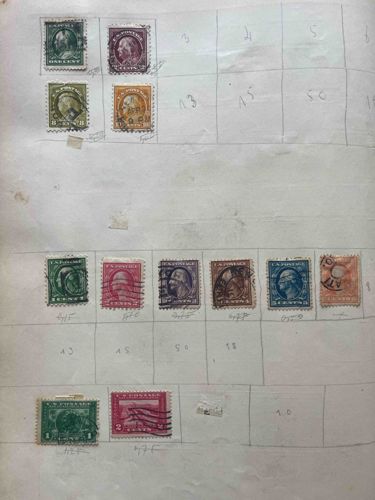
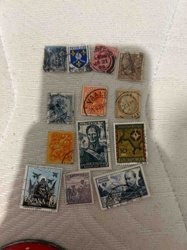
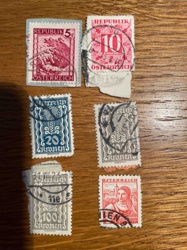
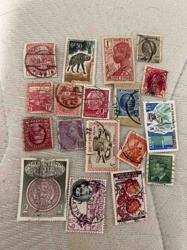
This item is a sheet from a stamp album featuring a collection of early 20th-century United States postage stamps. The page is a light cream or off-white color, divided into a grid pattern with faint pencil markings indicating potential catalog numbers or values next to some stamps, such as '13', '15', '50', '40', '45', '50', '18', '42F', '47E', and '47E'. There are 12 stamps affixed to the page spread across three rows. The top row contains four stamps, likely from the Washington-Franklin issue due to the portrait of George Washington. Two stamps in the top row are still attached by their original gum to what appears to be a stamp mount flap, one green (One Cent) and one purple (Two Cents). The other two, one green (One Cent) and one orange-brown (Two Cents, possibly with a 'B' or 'R' surcharge, though unclear), are not in mounts and show signs of having 'four-bar' cancellations, indicating previous use. The middle row displays six used stamps, all with postmarks/cancellations. These stamps depict portraits of prominent US figures, likely George Washington and Benjamin Franklin, in various denominations and colors including green, red, dark purple, brown, blue, and orange-pink. Many of these stamps exhibit heavy cancellations, some in black ink, obscuring portions of the design. The bottom row presents two stamps: a green 'One Cent' stamp and a red 'Two Cents' stamp, both exhibiting heavy cancellations, with the red stamp showing diagonal bars as a cancellation mark. Several stamps appear to have small hinge remnants attached to their backs or have been affixed with small, almost transparent hinges, suggesting they were previously mounted. The paper of the album page itself shows some discoloration and minor creasing, especially at the edges, consistent with age and handling. There are also a few small, loose stamp fragments or pieces of hinging scattered on the page. The perforations of the stamps vary slightly, typical of different production runs within this period. Overall, the collection represents a typical philatelic assortment of common early 20th-century US stamps, primarily from the Washington-Franklin series, valued more for their historical context and the interest of collecting than for high individual monetary worth in this condition.
AI Appraisal Report
I have examined the image provided, which shows a collection of early 20th-century United States postage stamps, predominantly from the Washington-Franklin series, affixed to an album page. Based on this visual assessment, I can offer the following appraisal.
**Condition and Authenticity:** The stamps appear authentic for the period, typical of common US issues. However, their condition is generally poor to fair. The majority are heavily canceled, with cancellations often obscuring much of the design. Several stamps show evidence of hinge remnants or being previously hinged, which is common but negatively impacts value on unused stamps. The two unused stamps in the top row, still attached to what appear to be mount flaps, present a slightly better condition but are still likely hinged. The album page itself exhibits discoloration and creasing, consistent with its age. Without physical inspection, it's impossible to verify gum condition, hinge status (unused examples), or any hidden faults like thinning or repairs.
**Market Conditions and Comparables:** This collection represents common early 20th-century US stamps, primarily of the Washington-Franklin issue, which were produced in vast quantities. The market for heavily canceled or common hinged stamps in less-than-optimal condition is generally low. Comparative sales of similar mixed lots of common used Washington-Franklin stamps typically fall in the range of a few dollars per stamp, or often sold as a group for a modest sum.
**Demand and Rarity:** There is a consistent but low demand for these common issues, primarily from beginner collectors or those seeking to fill spaces in basic albums. No rare varieties or high denominations are discernible from the image. The stamps are certainly not rare.
**Factors Impacting Value:** The primary factors limiting value are the commonness of the issues, the prevalent heavy cancellations, and the overall sub-optimal condition. The presence of unused examples is a slight positive, but their value is still heavily dependent on gum condition and hinge status, which cannot be determined from the image.
**Limitations of Verification:** A full authentication and accurate valuation would require physical examination. This would involve inspecting the gum on unused stamps, checking for thins, tears, repairs, and accurate perforation counts. I would also need to examine the cancellations more closely to ensure authenticity (e.g., no forged cancellations) and assess their impact on the stamp's appeal. Additionally, confirming the precise catalog numbers indicated by the faint pencil markings would require detailed inspection against a philatelic catalog. Without direct physical access, this appraisal is based solely on visual cues from the provided image and general knowledge of the philatelic market for such items.