AI Item Analysis
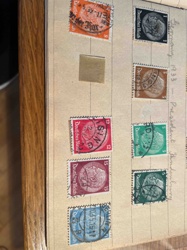
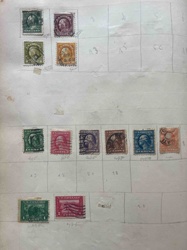
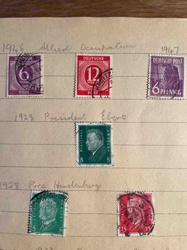
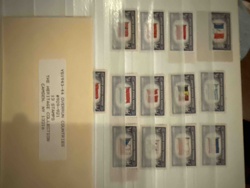
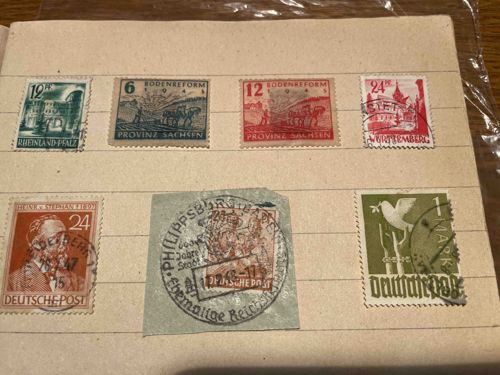
This item is an album page displaying a collection of seven German postage stamps, primarily from the immediate post-World War II era, affixed to a beige-colored album page with horizontal ruling. The stamps vary in size, color, and design, reflecting different regions and themes of post-war Germany.
Starting from the top row, left to right:
1. A green stamp with '12' denomination and 'Rheinland-Pfalz' printed at the bottom, featuring a building or castle.
2. A dark blue/green stamp with '6' denomination, 'Bodenreform 1945' (Land Reform 1945) and 'Provinz Sachsen' (Province of Saxony), depicting farmers plowing.
3. A red stamp, similar in design to the previous one, with '12' denomination, 'Bodenreform' and 'Provinz Sachsen'.
4. A red stamp with '24' denomination and 'Württemberg', showing a stylized cityscape or castle.
Bottom row, left to right:
1. An orange-red stamp with '24' denomination, featuring a portrait of 'Heinrich von Stephan', with 'Deutsche Post' at the bottom. This stamp is postmarked, somewhat obscuring the portrait.
2. A larger, irregularly shaped, light greenish-gray piece of paper, likely a stamp or part of an envelope, with a circular town cancel 'PHILIPPSBURG' and text 'ehemalige Reichs' (former Reich) and what appears to be part of a rectangular stamp with 'DEUTSCHE POST'. This item appears to be either a heavily cancelled stamp on a piece of original paper or a segment of a postal history item, possibly a piece from a postcard or cover showcasing the cancellation.
3. A green stamp with '1 MARK' denomination and 'Deutsche Post', featuring a dove of peace and bare trees/branches. This stamp is also postmarked in black, partially obscuring the design.
The stamps exhibit various conditions. Some appear to be used, indicated by visible cancellations. The paper quality of the stamps seems consistent with their estimated age. The album page itself shows some minor discoloration consistent with age and storage, although no significant tears or creases are evident on the visible portion. The stamps are affixed, likely with hinges, which is a common practice in philately but can sometimes affect the gum on unused stamps. The style period is clearly post-WWII German philately, primarily from the zonal and early federal/democratic post-office issues. The philatelic material points to a focus on early post-war reconstruction/themes like land reform and peace, alongside individual portraits and regional issues. This collection offers a glimpse into Germany's postal history during a critical transitional period.
The item is generally in good condition for its age, considering it's part of a collection and not individual mint stamps. The readability of the cancellations and the clarity of the stamp designs are good enough for identification. The album page itself provides a clean and organized presentation for these stamps.