AI Appraisal Estimate

AI-generated estimates · not official valuations

From the user

What was submitted

Photo and notes provided by the user — not generated by AI

Submitted item photo
Submitted photo · June 13, 2026

User's notes

No additional notes provided.

AI analysis below

AI appraisal

AI analysis & estimate

AI-Generated · Verify before acting

Everything below is generated by AI for informational purposes only. AI can make mistakes — the AI may misidentify items or misattribute them (artist, maker, brand, designer, origin, era). This is not an official valuation and should not be used for insurance, sale, tax, estate, legal, or lending purposes — or any decision requiring a certified appraisal. It is not an authoritative claim about any person, brand, or rights holder — do not share or rely on it as a factual statement about a third party. Always consult qualified professionals before making financial decisions.

Read the full disclaimer

AI Identification

·Not independently authenticated·Verify before acting

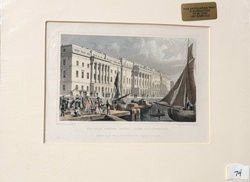
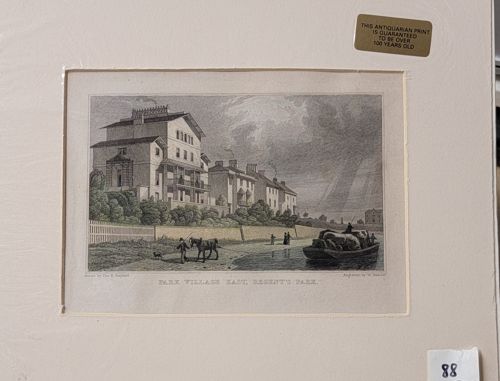
Park Village East, Regent's Park - Antique Steel Engraving by Thomas Shepherd

Antique Prints and Artworks

AI Estimated Value

·Not an official valuation·Verify before acting

$45.00 - $75.00

As of June 13, 2026

AI Item Analysis

·AI can make mistakes·Verify before acting
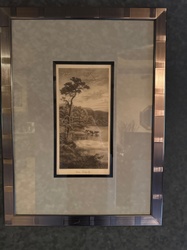
This is a 19th-century steel-engraved topographical print entitled 'Park Village East, Regent's Park'. The artwork was originally drawn by Thomas Hosmer Shepherd and engraved by W. Radclyffe. The scene depicts an architectural landscape of early Victorian houses overlooking the Regent's Canal in London. A towpath is visible in the foreground with a horse pulling a barge loaded with goods, alongside small human figures and a dog, which adds narrative scale to the composition. The print is monochrome, executed with fine, precise lines characteristic of steel engraving, allowing for intricate detail in the brickwork, foliage, and dramatic sky. Physically, the print is housed in a cream-colored bevel-cut window mat. A gold authenticity sticker in the upper right corner states, 'THIS ANTIQUARIAN PRINT IS GUARANTEED TO BE OVER 100 YEARS OLD', while a small white tag in the bottom right corner displays the number '88', likely a lot or inventory number. The paper exhibits a slight age-related yellowing (patina) consistent with mid-19th-century paper stock. The engraving shows high level of craftsmanship, particularly in the rendering of light and shadow on the buildings. There are no major visible tears or water damage, though slight undulation of the paper is possible under the matting.
AI Appraisal Report

·AI can make mistakes·Verify before acting
I have virtually examined this 19th-century steel engraving by Thomas Hosmer Shepherd, engraved by W. Radclyffe. The piece is a classic representation of 'London in the Nineteenth Century,' a series highly popular during the Victorian era. The condition appears fair to good; the slight yellowing is consistent with the age of the paper stock, and the fine lines of the engraving remain crisp, suggesting this was an early strike from the steel plate. Such prints were mass-produced for topographical publications, which impacts their rarity significantly. In the current market, works by Shepherd are common. While they possess historical and architectural charm, the supply is high. Comparable sales for Shepherd engravings of this size and subject matter typically fall within the $40 to $80 range at retail. The inclusion of the 'Guaranteed over 100 years old' sticker suggests a prior gallery or antique shop provenance, though it does not inherently increase the value beyond decorative standards. The demand remains steady among local London historians and collectors of 19th-century architectural prints. Critically, a digital examination limits definitive authentication. To confirm this is an original 1830s/40s strike rather than a later 19th-century reproduction or a 20th-century lithographic facsimile, I would need to examine the paper for a watermark, check for the presence of a plate mark (indented perimeter), and use high-magnification to ensure the ink sits in the grooves of the paper rather than on the surface as a dot-matrix. I would also need to remove the matting to inspect for 'foxing' (acid spots) or hidden trimming on the margins, which would negatively impact the value.

Get your items appraised

Instant estimates of your treasures with AI-powered appraisals

Browse More Appraisals