These notes were written by the person who submitted this item. Appraiser.AI has not verified them, and the AI's identification and estimate may rely on them.
AI Estimated Value
Not an official valuation
$100-200
AI estimate as of November 7, 2025 · verify with a professional before acting
AI-Generated · Verify before acting
Everything on this page is generated by AI for informational purposes only. AI can make mistakes — the AI may misidentify items or misattribute them (artist, maker, brand, designer, origin, era). This is not an official valuation and should not be used for insurance, sale, tax, estate, legal, or lending purposes — or any decision requiring a certified appraisal. It is not an authoritative claim about any person, brand, or rights holder — do not share or rely on it as a factual statement about a third party. Always consult qualified professionals before making financial decisions.
This analysis also relies on unverified notes provided by the user, which may be incomplete or inaccurate and could affect the result.
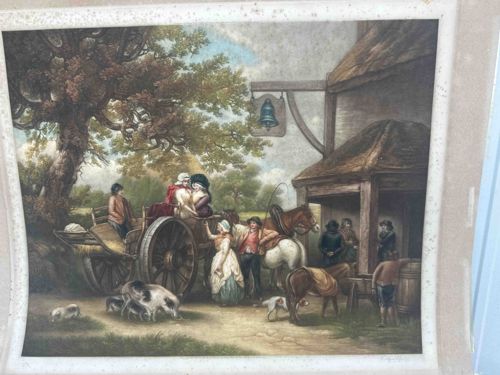
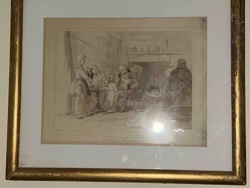
This item is an old, likely hand-colored, engraving or print depicting a busy scene outside 'The Bell Inn'. The scene is rich with period detail, featuring a horse-drawn cart with multiple passengers, several individuals engaged in conversation or activity near the inn, and various animals including pigs and a donkey. A large, gnarled tree dominates the left side of the composition, offering shade, while the inn itself, with its thatched roof and a sign depicting a bell, occupies the right. The color palette is earthy and somewhat muted, characteristic of 18th or early 19th-century prints, with greens, browns, and subdued reds and blues in the clothing of the figures. Details such as the spoke-wheeled cart, the period attire of the people, and the architectural style of the inn suggest an estimated age from the late 18th to the mid-19th century, aligning with the Georgian or early Victorian era in Britain. The print appears to be mounted or framed, with some visible white border around the image area. There are visible condition issues, including what appears to be foxing or discoloration spots, particularly noticeable in the sky area and on the white border, indicating age and environmental exposure. The edges of the paper surrounding the artwork also show signs of wear and possibly some minor creasing, although the central image seems relatively intact. The craftsmanship suggests a commercially produced print, possibly an aquatint or stipple engraving, later colored by hand to enhance its appeal. The quality of the detail in the figures and the landscape suggests a skilled engraver and colorist, indicative of prints produced for a broader market of collectors or for decorative purposes.
AI Appraisal Report
This item is an antique engraving or print, likely hand-colored, depicting 'The Bell Inn'. Based on the stylistic elements, period details, and coloring, I assess its age to be late 18th to mid-19th century, aligning with the Georgian or early Victorian era. The details, such as the horse-drawn cart and period attire, support this dating. The craftsmanship suggests a commercially produced work, possibly an aquatint or stipple engraving, later enhanced with hand-coloring.Condition is a significant factor here. I observe notable foxing and discoloration, particularly in the sky and on the white border, indicative of age and environmental exposure. The edges show wear and possibly minor creasing, though the central image appears largely intact. These condition issues detract from its overall appeal and value. While the subject matter is charming and historical, the market for such antique, un-matted or poorly matted, and foxed prints is moderate. Demand is generally from collectors interested in specific historical scenes or period decor. Comparables in similar condition typically fall within a modest range.The limited authenticity verification from images alone is a crucial point. While the visual evidence strongly suggests an authentic period print, a definitive confirmation would require in-person examination. This would allow for a detailed inspection of the paper quality, printing process (e.g., plate marks, ink consistency), and pigment analysis for the hand-coloring to confirm its originality and age. Without physical inspection, I cannot rule out the possibility of a later reproduction, although the visible wear and foxing suggest genuine age. Provenance documentation, if available, would significantly enhance its value and confirm its history.