AI estimate as of November 12, 2025 · verify with a professional before acting
AI-Generated · Verify before acting
Everything on this page is generated by AI for informational purposes only. AI can make mistakes — the AI may misidentify items or misattribute them (artist, maker, brand, designer, origin, era). This is not an official valuation and should not be used for insurance, sale, tax, estate, legal, or lending purposes — or any decision requiring a certified appraisal. It is not an authoritative claim about any person, brand, or rights holder — do not share or rely on it as a factual statement about a third party. Always consult qualified professionals before making financial decisions.
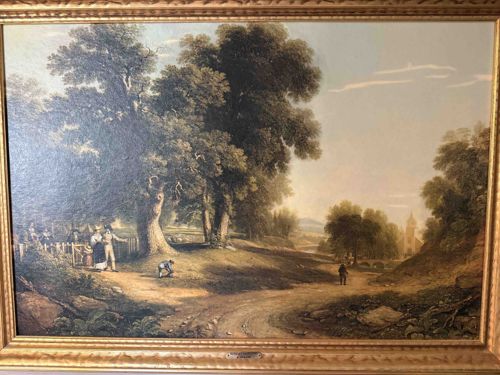
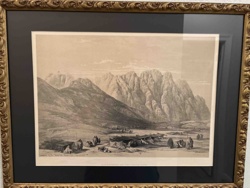
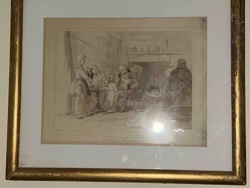
This item is a framed landscape print or engraving, likely dating from the late 18th or early 19th century, characteristic of the British Romantic landscape tradition. The print depicts a bucolic rural scene with a winding dirt path leading through a treed landscape. In the foreground to the left, a group of figures interaction near a wooden fence and large trees, suggesting a village or settled area. A woman in a white cap and apron appears to be speaking with a man, while another figure kneels on the ground nearby. Further along the path, a lone figure walks towards a distant village with a prominent church steeple, visible on the right side of the composition. The sky is partially cloudy, suggesting a pleasant day. The detailed rendering of foliage, particularly the diverse trees with their distinct leaf patterns and heavy canopies, indicates a high level of craftsmanship in the original artwork and its reproduction. The colors predominantly feature greens, browns, and muted blues for the sky, with some earthy tones in the path and figures. The print is housed in a period-appropriate gilded wooden frame with a decorative carved or molded leaf motif along the inner edge. The frame shows signs of age, including minor wear to the gilt finish, some areas of darkening, and possible small chips or abrasions consistent with its age. There are no visible maker's marks or signatures on the print itself, although a small, possibly embossed or printed mark might be present at the bottom center of the frame, which is partially obscured or indistinct in the image. The overall condition appears good for its age, though the print itself might exhibit some subtle discoloration or fading under closer inspection. The item conveys a sense of historical charm and natural beauty, executed with fine detail and illustrative quality typical of the era's printmaking.
AI Appraisal Report
This framed 18th/19th-century British landscape engraving/print presents as a charming example of the Romantic landscape tradition. The depiction of a rural scene with figures, a winding path, and a distant village is characteristic of the period's aesthetic preferences. Based on the visual examination of the image, the print appears to be in good condition commensurate with its age, though slight discoloration or fading cannot be ruled out without physical inspection. The period-appropriate gilded frame with its decorative leaf motif, despite signs of wear like darkening and minor gilt loss, enhances its presentation and authenticity.
Authenticity, while strongly suggested by the style and framing, cannot be definitively confirmed from images alone. A physical examination is crucial to assess paper type, watermarks (if any), printing technique (engraving vs. mezzotint vs. etching), and to meticulously search for any un-obscured artist's signatures, printmaker's marks, or publication details. Provenance, such as previous ownership records or exhibition history, would further solidify its authenticity and potentially increase its value. Scientific testing of the paper and inks could also provide definitive dating.
Market conditions for late 18th/early 19th-century British landscape prints are stable, with demand for good quality, well-preserved examples. Comparables typically range from a few hundred to over a thousand dollars depending on the artist's prominence, rarity of the print, and overall condition. This piece, being unsigned and not attributed to a known master, falls into the mid-range of this market. The fine detail and illustrative quality indicate a skilled hand, even if anonymous. Rarity is difficult to ascertain without knowing the edition size if any. The primary factors impacting value are its condition, the aesthetic appeal of the scene, the period-appropriate framing, and the lack of a prominent artist's signature. Should a significant artist be identified through further inspection, the value could increase substantially.