AI estimate as of December 11, 2025 · verify with a professional before acting
AI-Generated · Verify before acting
Everything on this page is generated by AI for informational purposes only. AI can make mistakes — the AI may misidentify items or misattribute them (artist, maker, brand, designer, origin, era). This is not an official valuation and should not be used for insurance, sale, tax, estate, legal, or lending purposes — or any decision requiring a certified appraisal. It is not an authoritative claim about any person, brand, or rights holder — do not share or rely on it as a factual statement about a third party. Always consult qualified professionals before making financial decisions.
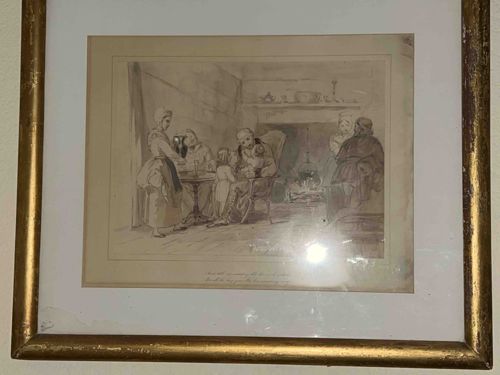
This item is a framed engraving or print depicting a domestic interior scene, likely dating from the 19th century. The artwork itself is rendered in monochrome, appearing to be a sepia-toned or black-and-white print, possibly an etching or mezzotint, derived from a drawing. The scene portrays several figures gathered around a table in what appears to be a humble household setting, with a fireplace visible in the background. A woman in a bonnet and apron stands on the left, serving from a pitcher. Male figures, and possibly a child, are seated or standing. The style suggests a genre scene typical of the Romantic or Victorian era, focusing on everyday life. The print exhibits visible signs of age, including potential discoloration or foxing on the paper, consistent with its likely historical period. It is housed in a prominent, possibly original, wooden frame with a gilded finish. The frame displays significant wear and tear, characterized by chipped gilding, scratches, and abrasions, revealing the underlying wood. The frame's corners show some separation and damage. A white mat board surrounds the artwork, which also appears aged and may have some staining or yellowing. The artwork is protected by a sheet of glass, which shows reflections and some surface dust or smudges in the provided image. The overall condition suggests a piece that has been displayed for a long period without significant restoration. The craftsmanship of the print itself is finely detailed, typical of period engravings, capturing expressions and textile textures. The frame, while aged, also appears to be of a certain quality, designed to complement the artwork. The precise nature of the print (original engraving vs. later reproduction) would require closer inspection.
AI Appraisal Report
Based on my visual examination of the provided image, this Framed 19th Century Domestic Scene Engraving/Print depicts a genre scene consistent with the Romantic or Victorian era. The monochrome print, possibly an etching or mezzotint, shows fine detail in the figures and setting. Its condition, with visible discoloration or foxing, aligns with its probable age. The prominent wooden frame with gilded finish, while original in appearance, exhibits significant wear including chipped gilding, scratches, and corner separation. The mat board also appears aged and potentially discolored.
Market conditions for 19th-century domestic scene prints, particularly those without a named, prominent artist, are generally modest. Demand is present but not robust, and many similar pieces exist, diminishing rarity. The primary value contributors here are the aesthetic appeal of the scene and the age of the piece, balanced against its worn condition. The frame's damage is a significant factor impacting value negatively.
It is crucial to note that absolute authenticity (original engraving vs. later reproduction) cannot be definitively determined from images alone. A physical inspection would be necessary to examine the paper quality, printing process (e.g., plate marks for an intaglio print), and to confirm the medium. Provenance documentation could also significantly impact value. Without such verification, I am assessing this as a period print and frame in fair to good condition, considering its age, with wear appropriate for its historical context but also detracting from its overall presentation.