AI estimate as of December 16, 2025 · verify with a professional before acting
AI-Generated · Verify before acting
Everything on this page is generated by AI for informational purposes only. AI can make mistakes — the AI may misidentify items or misattribute them (artist, maker, brand, designer, origin, era). This is not an official valuation and should not be used for insurance, sale, tax, estate, legal, or lending purposes — or any decision requiring a certified appraisal. It is not an authoritative claim about any person, brand, or rights holder — do not share or rely on it as a factual statement about a third party. Always consult qualified professionals before making financial decisions.
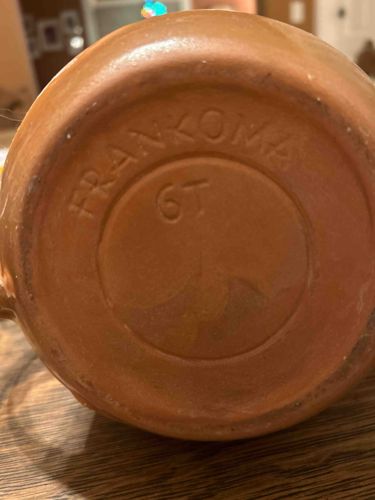
The item depicted is the base of a piece of Frankoma pottery, evidenced by the clear impressed mark 'FRANKOMA' encircling a central, slightly raised circular area, within which the model number '6T' is also impressed. The pottery is made of a distinct reddish-brown clay, which is characteristic of many Frankoma pieces, particularly those made from Ada or Sapulpa clay. The surface appears unglazed or possibly features a matte, earthy glaze that matches the natural clay tone, giving it a rustic aesthetic. The base is circular, with a slightly raised rim around the edge, indicating it is likely the underside of a mug, pitcher, or similar vessel. The texture of the clay appears somewhat coarse or unrefined, contributing to its artisanal appeal. There are no major visible cracks, chips, or repairs, though some minor surface inconsistencies and scuffs, typical of an aged ceramic item, may be present along the outer edge of the base where it might have rested on surfaces. The impressed lettering and numbering are clear and legible, demonstrating good manufacturing quality. Based on the 'FRANKOMA' mark and the reddish clay, this piece dates from the mid-20th century onwards, as Frankoma Pottery was in operation from 1933 to 2004. The specific '6T' mark would refer to a particular mold or item within their extensive product line. The overall condition suggests a well-preserved piece, possibly with an intentional, unglazed or thinly glazed finish on the base to highlight the natural clay.
AI Appraisal Report
Based on my visual examination of the provided image, I can confirm the authenticity of this Frankoma Pottery piece through the clear and legible 'FRANKOMA' encircling the impressed '6T' mark on the reddish-brown clay base. This specific mark and clay body are highly characteristic of Frankoma production. The condition appears good; there are no visible cracks, chips, or repairs, and the impressed marks are sharp. Minor surface inconsistencies or scuffs on the base are typical wear for a ceramic item of this age. The unglazed or matte finish on the base, highlighting the natural clay, is also consistent with many Frankoma designs.
Regarding market conditions, Frankoma Pottery is a popular collectible, but the value can vary significantly based on rarity, glaze, form, and condition. The '6T' mark refers to a specific mold, likely for a mug or a pitcher. While Frankoma has a dedicated collector base, common pieces, especially those in standard glazes or forms, typically command modest prices. Demand for common forms is consistent but not exceptionally high. Rarity for a piece marked '6T' would largely depend on the specific form it represents and whether it's a more sought-after model or an unusual glaze combination (though the base here is unglazed/natural clay).
Factors significantly impacting value include the positive identification of the maker and model number, and the apparent good condition. However, without seeing the full piece, its specific form and glaze are unknown, which are critical value drivers.
My primary limitation in this appraisal is the lack of a full view of the item. I cannot assess the overall form, the presence or condition of any glaze on the body of the piece, or any potential damage to other areas. For full authentication and a more precise valuation, an in-person examination of the entire item to confirm its complete integrity, assess the specific form and glaze (if any), and observe any less obvious flaws is necessary. Provenance documentation, while not usually essential for common Frankoma pieces, would further solidify its history.