AI estimate as of August 19, 2025 · verify with a professional before acting
AI-Generated · Verify before acting
Everything on this page is generated by AI for informational purposes only. AI can make mistakes — the AI may misidentify items or misattribute them (artist, maker, brand, designer, origin, era). This is not an official valuation and should not be used for insurance, sale, tax, estate, legal, or lending purposes — or any decision requiring a certified appraisal. It is not an authoritative claim about any person, brand, or rights holder — do not share or rely on it as a factual statement about a third party. Always consult qualified professionals before making financial decisions.
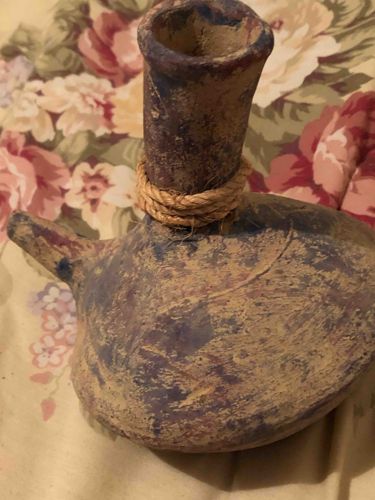
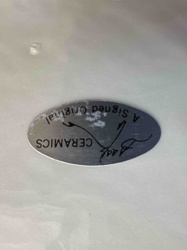
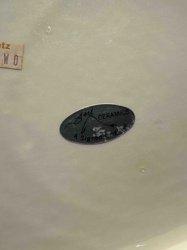
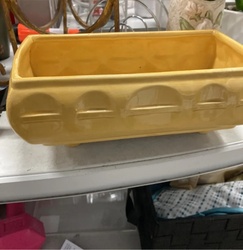
This appears to be an antique or tribal-style pottery vessel, possibly a dipper or a single-handled jug. Its primary physical characteristics include a rounded, flattened body and an elongated, relatively narrow cylindrical neck that flares slightly at the mouth. A protruding spout or small handle is visible on one side of the main body, suggesting its potential use for pouring. The material appears to be unglazed earthenware or terracotta, possibly hand-built through coiling or pinching. The coloration is predominantly a mottled mix of earthy browns, tans, and hints of a deep purplish-blue or dark indigo, suggesting natural mineral pigments or dyes that have weathered over time. The surface exhibits a rough, textured finish, consistent with traditional or rustic pottery techniques. A notable feature is the presence of a double-coiled rope, possibly made of natural jute or hemp fibers, neatly tied around the base of the neck, adding to its rustic aesthetic and potentially serving as a decorative or reinforcing element. Visible condition issues include significant surface wear, consistent with age and handling, evidenced by the flaking or rubbing off of the surface coating/pigment in various areas, revealing the underlying clay body. There are no obvious signs of recent repairs or significant damage like large chips or cracks, but the overall patina suggests considerable age. No maker's marks, signatures, or specific manufacturing stamps are discernible from the image, which is common for handmade or folk art pieces. The style suggests it could be a piece of pre-Columbian, African, or Native American pottery, or a modern reproduction in a similar ethnic or rustic style. The craftsmanship appears artisanal, with slight irregularities indicative of hand-molding rather than mass industrial production. The natural materials and distressed finish contribute to a sense of antiquity and unique charm.
AI Appraisal Report
I have examined the image of this Rustic Handled Pottery Vessel. Based on its visual characteristics, it appears to be a hand-built earthenware or terracotta piece, possibly an antique or tribal-style dipper/jug. The rounded, flattened body, elongated cylindrical neck, and integral pouring spout or small handle are consistent with utilitarian pottery from various cultures. The mottled earthy tones, coupled with hints of purplish-blue and a rough, textured finish, suggest natural mineral pigments and rustic firing techniques. The double-coiled rope further enhances its folk art aesthetic.
Condition-wise, significant surface wear and pigment flaking are evident, consistent with considerable age and handling. This patina, while showing wear, does not reveal major structural damage like large cracks or repairs, which is positive. The artisanal craftsmanship, with slight irregularities, points away from mass industrial production and towards handmade origins.
Authenticity verification from images alone is severely limited. While the style evokes pre-Columbian, African, or Native American pottery, it could also be a modern reproduction in a similar style. The lack of discernible maker's marks is common for such pieces, but also offers no immediate provenance. For full authentication, I would require a physical examination to assess the clay body, firing technique, and pigment composition (e.g., through thermoluminescence dating or spectroscopy) to determine genuine age and origin. Provenance documentation, if available, would be invaluable.
Market conditions for such pieces are driven by proven antiquity, cultural significance, and rarity. If genuinely ancient, tribal, or pre-Columbian, demand can be high, but if a modern decorative piece, significantly lower. Without confirmed provenance or scientific testing, its market value is primarily based on its decorative appeal as a rustic, handcrafted object.