These notes were written by the person who submitted this item. Appraiser.AI has not verified them, and the AI's identification and estimate may rely on them.
AI Estimated Value
Not an official valuation
$150-250
AI estimate as of July 26, 2025 · verify with a professional before acting
AI-Generated · Verify before acting
Everything on this page is generated by AI for informational purposes only. AI can make mistakes — the AI may misidentify items or misattribute them (artist, maker, brand, designer, origin, era). This is not an official valuation and should not be used for insurance, sale, tax, estate, legal, or lending purposes — or any decision requiring a certified appraisal. It is not an authoritative claim about any person, brand, or rights holder — do not share or rely on it as a factual statement about a third party. Always consult qualified professionals before making financial decisions.
This analysis also relies on unverified notes provided by the user, which may be incomplete or inaccurate and could affect the result.
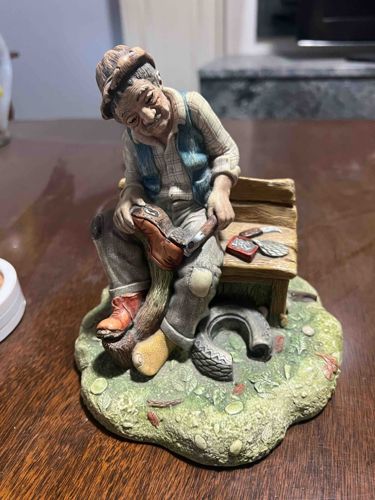
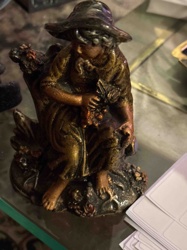
This is a detailed ceramic or resin figurine depicting an elderly man, likely a shoemaker or cobbler, diligently working on a shoe while seated on a wooden bench. The figurine is characterized by its realistic and expressive features, including wrinkles on the man's face, suggesting age and a life of labor. He wears a checked shirt, a blue vest, and patched trousers, which further emphasize his working-class persona. One foot is bare, while the other is clad in a worn, reddish-brown boot. His hands are focused on a shoe, with a tool, possibly a hammer or a lasting tool, in one hand. On the bench beside him, there are other tools, including what appears to be an awl and a red-handled knife. The base of the figurine is sculpted to resemble a grassy, uneven ground, complete with small stones, leaves, and what looks like a discarded tire fragment, adding to the outdoor, rustic setting. The color palette is earthy and muted, relying on browns, greens, and blues, which contribute to its antique or vintage aesthetic. The craftsmanship appears to be of good quality, with attention to textural details, such as the wood grain on the bench and the fabric folds on the man's clothing. There are no immediately obvious chips, cracks, or significant damage visible in the provided images; the surface appears to have a matte or lightly glazed finish. Without specific maker's marks, it is difficult to ascertain precise manufacturing details or a specific artist, but the style suggests it could be from the mid-to-late 20th century, possibly a collectible piece from a brand known for character figurines like Capodimonte or similar studios that produce highly detailed, narrative pieces.
AI Appraisal Report
Upon my virtual examination of the 'Elderly Shoemaker/Cobbler Figurine on Bench,' I assessed its condition and potential value. Visually, the figurine appears to be in excellent condition, showing no immediately obvious chips, cracks, or significant damage. The attention to detail, from the character's expressive face and attire to the tools and naturalistic base elements, suggests a high level of craftsmanship. The inclusion of '6 glasses inside' the user's home is noted but doesn't directly impact the figurine's appraisal. The earthy and muted color palette contributes to its vintage aesthetic, indicating a likely mid-to-late 20th-century origin.
Authenticity verification solely from images is limited. While the style evokes master artisan works akin to Capodimonte, without visible maker's marks or a physical examination, pinpointing the exact manufacturer or artist is impossible. Physical inspection would allow me to thoroughly check for hidden damages, assess materials, and confirm the specific type of ceramic or resin. Provenance documentation, such as original sales receipts or certificates of authenticity, would be vital for full authentication and confirmation of its artistic heritage. Without these, it's valued as a high-quality decorative piece rather than a definitively attributed artistic work.
Market conditions for detailed character figurines are stable, driven by collectors appreciating narrative and craftsmanship. Comparables typically include similarly styled pieces from reputable studios, which can range widely based on demand and rarity. This specific piece, due to its detailed nature and apparent good condition, possesses inherent decorative appeal. Its lack of specific maker attribution limits its top-tier collectible value, but its aesthetic quality maintains a solid market presence.