These notes were written by the person who submitted this item. Appraiser.AI has not verified them, and the AI's identification and estimate may rely on them.
AI Estimated Value
Not an official valuation
$25-50
AI estimate as of December 7, 2025 · verify with a professional before acting
AI-Generated · Verify before acting
Everything on this page is generated by AI for informational purposes only. AI can make mistakes — the AI may misidentify items or misattribute them (artist, maker, brand, designer, origin, era). This is not an official valuation and should not be used for insurance, sale, tax, estate, legal, or lending purposes — or any decision requiring a certified appraisal. It is not an authoritative claim about any person, brand, or rights holder — do not share or rely on it as a factual statement about a third party. Always consult qualified professionals before making financial decisions.
This analysis also relies on unverified notes provided by the user, which may be incomplete or inaccurate and could affect the result.
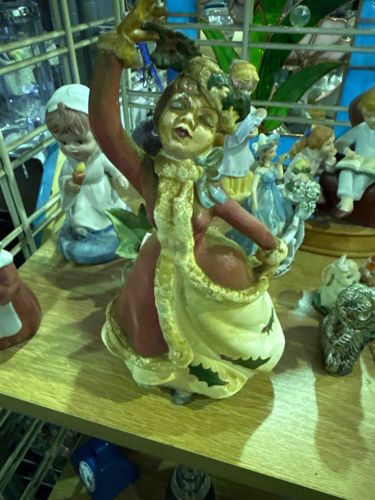
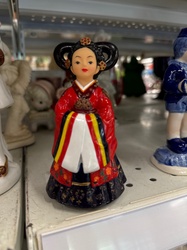
This item is a mold-painted ceramic or plaster figure depicting a female in a festive, possibly winter or Christmas-themed, outfit. The figure stands upright, appearing to be in motion, perhaps dancing or reaching. She wears a reddish-brown dress or coat with a wide, yellowish-cream trim, which is adorned with green holly leaves along the bottom edge, suggesting a holiday theme. A matching yellowish-cream scarf or boa is wrapped around her neck. Her hair is short and appears to be sculpted with some detail. She has her mouth slightly open, and her eyes are closed, giving her an expressive, joyful appearance. Her right arm is raised above her head, and her left arm is bent at the elbow, held closer to her body. The overall construction suggests it was cast from a mold, then hand-painted, a common technique for hobby ceramics or plastercraft. The painting shows some unevenness and texture, indicative of a home-finished piece rather than factory-produced fine porcelain. The colors are muted but distinct, with reds, creams, greens, and flesh tones. The figure is likely sitting on a small, integrated base. The condition appears to be relatively good, with no obvious chips or cracks visible in the provided image, though the paint finish might exhibit some wear or minor flakes upon closer inspection. The style points towards a mid-to-late 20th-century aesthetic, likely from the 1960s-1980s, common for Atlantic Molds or similar hobby ceramic manufacturers. The 'Atlantic' context provided confirms this origin. This piece showcases a folk art or craft quality, displaying the individual hand-painting style of the creator.